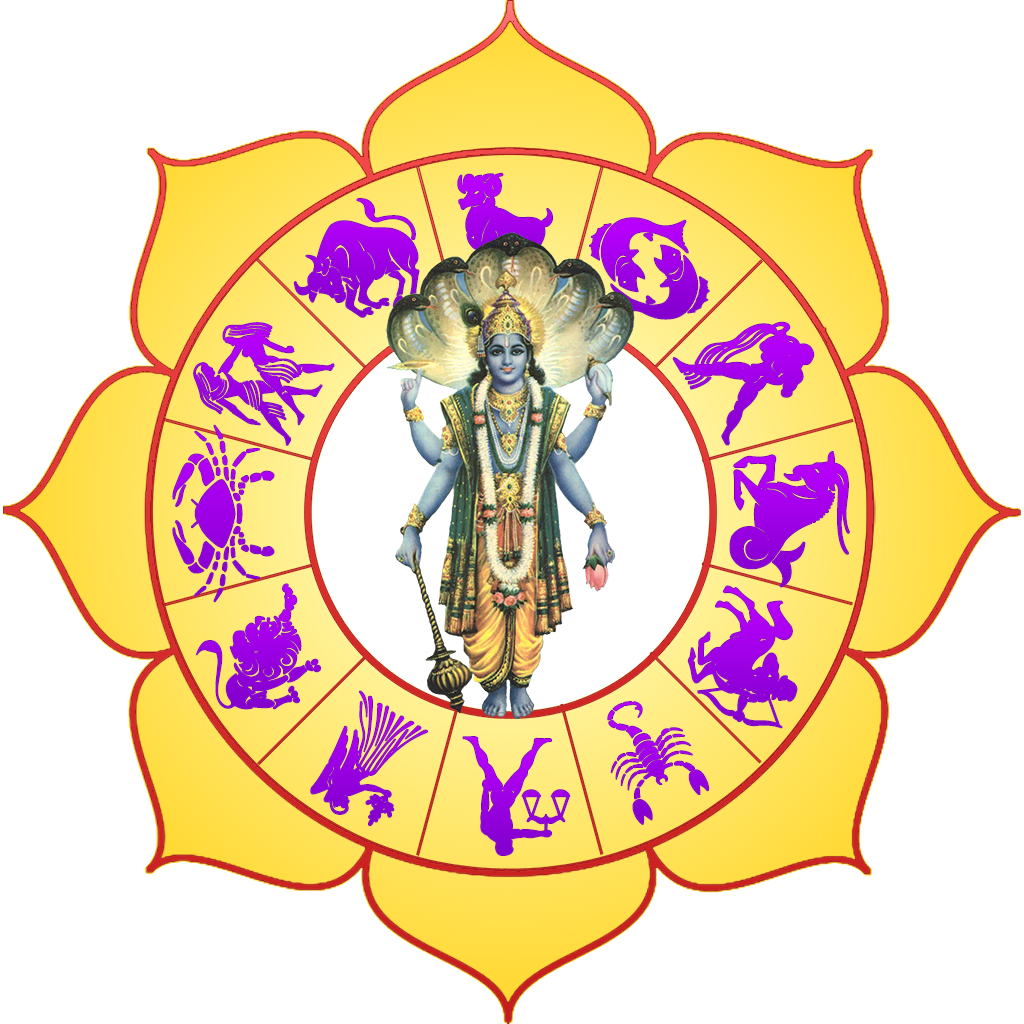
Whichever rāśi a particular division is in, the lord of the said division shall be the same as the rāśi it is mapped to.
 This is the first fundamental principle taught by Parāśara.
Every rāśi of 30° can be divided into various divisions. These divisions of the sign are mapped into other signs based on certain criteria which was used for their creation. Normally there are equal divisions of a sign while at other times the divisions are of unequal size.
Consider the one-twelfth division of a sign. This is called dvādaśāṁśa from the word dvādasa meaning “12” and aṁśa meaning division. As a first step we divide a rāśi (30°) into 12 parts where each part measures exactly 2°30’. Now the rule for mapping – the first dvādaśāṁśa of a rāśi is in the same rāśi; subsequent dvādaśāṁśa are in the regular zodiacal order. Using this rule let us determine the dvādaśāṁśa of the sign Aries. The first dvādaśāṁśa of Aries (0° – 2°30’) maps to Aries itself. The second dvādaśāṁśa of Aries (2°30’ – 5°) maps to the second sign Taurus. In this manner the 12 dvādaśāṁśa of Aries will map to the twelve signs from Aries to Pisces.
Table: Twelve Dvādaśāṁśa Map for Aries
| D12 | Deg | Map | Lord | D12 | Deg | Map | Lord |
| 1 | 2°30′ | Ar | Ma | 7 | 17°30′ | Li | Ve |
| 2 | 5° | Ta | Ve | 8 | 20° | Sc | Ma |
| 3 | 7°30′ | Ge | Me | 9 | 22°30′ | Sg | Ju |
| 4 | 10° | Cn | Mo | 10 | 25° | Cp | Sa |
| 5 | 12°30′ | Le | Su | 11 | 27°30′ | Aq | Sa |
| 6 | 15° | Vi | Me | 12 | 30° | Pi | Ju |
What śloka 5 ½ teaches us is that every of these twelve divisions of Aries is mapped exactly into another rāśi in a special chart called dvādaśāṁśa or simply D12 Chart. Secondly, the lordship of these divisions in the special chart is exactly the same as the rāśi chart. For example, the sixth division of Aries is present at 12°30’ to 15° of Aries in the Kṣetra (D1 Chart) and this is mapped to Virgo in the D12 chart and this division is also ruled by Mercury who is the lord of Virgo.
Division refers to an orderly division of the 30 degrees of a sign into parts called Amsa. The charts constructed on the basis of the ownership of these divisions[1] are called Divisional Charts or simply D-Charts. The sign is divided into ‘N’ number of parts where ‘N’ refers to the Varga number. Each part is called an Amsa and maps into a specific sign of the D-N Chart. If any planet or Lagna is placed within an Amsa, then it is also in the mapped sign of the D-Chart.
To understand this, let us consider the chart of a person born on the 7th of August 1963. Some of the planetary positions are Lagna 140 Pisces, Jupiter 260 07’ Pisces, Moon 19057’ Aquarius and Saturn 26050’ Capricorn. The Rasi (D-1 Chart) will have Jupiter and Ascendant in the first house in Pisces, Moon in the 12th house in Aquarius and Saturn in the 11th house in Capricorn. Let us attempt to determine the Drekkana divisions and D-3 chart. Here ‘N’ = 3 and each sign of 300 longitude is divided into three parts of 100 each. Each of these divisions is called an ‘Amsa’ and more specifically a Drekkana or ‘Trine division’. The three Drekkana of all signs would be in the longitude range (1) 0-100, (2) 100-200 and (3) 200-300. The first Drekkana of a sign is mapped to itself, the second is mapped to the sign in the fifth from it and the third is mapped to the sign in the ninth from it.
Figure 4: D-Chart construction

Thus, Lagna at 140 Pisces is in second Drekkana and is mapped into Cancer the fifth house from Pisces. Jupiter at 260 is in the third Drekkana of Pisces and this is Scorpio in the D-3 Chart. Moon is in the second Drekkana of Aquarius and is placed in Gemini in D-3 Chart. Saturn at 270 is in the third Drekkana of Capricorn and is mapped to the ninth house from Capricorn (i.e. Virgo) where it is placed in the D-3 Chart.
The divisions of the zodiac and the divisional charts constructed on the basis of ownership of these divisions are named on various criteria. These include:
- The division number: This is the numer by which the sign is divided into parts. For example ‘Saptamsa’ composed from Sapta meaning seven and amsa meaning portion. Thus, this is the one-seventh division of a sign.
- Other reference numbers: For example, it is well known that there are 27 Nakshatra. Hence the name Nakshetramsa coined from Nakshatra and Amsa (portion) refers to the one – twenty seventh (1/27) division or the divisional chart prepared from this division occupied by the Lagna and nine planets.
- Usage and focus: Every divisional chart (or division) has a specific use and a clearly defined focus on a specific area of activity. For example, Siddhamsa is coined from Siddha referring to that body of knowledge which a person learns and achieves perfection in and Amsa means portion. So, Siddhamsa refers to the division/divisional chart where we study the learning process. This is the 24th division (D-24 Chart). This is also called the Bhamsa from the word ‘Bha’ (as in Bha-chakra which is the primary representation of the zodiac as composed of 27 Nakshatra.
- Multiple names: Divisions (D-charts) can have multiple names from either of the three aforementioned methods. For example the 16th division is called Shodasamsa [Shodas (sixteen) Amsa (portion)]. This is also called Kalamsa based on the 16 Kala’s in a 24-hour day.
- Standard Method: The nomenclature introduced by modern Vedic astrologers refers to each divisional chart directly by its division number. For example, the Siddhamsa is simply called the D-24 Chart or just D-24 when the division in the Rasi chart is being referred to.
Table 3: Nomenclature
| Division | Primary Name | Other names |
| D-1 Chart | Rasi | Bhagana, Bha chakra |
| D-2 Chart | Hora | |
| D-3 Chart | Drekkana | |
| D-4 Chart | Chaturthamsa | Tureeyamsa |
| D-5 Chart | Panchamamsa | |
| D-6 Chart | Shastamsa | Kauluka |
| D-7 Chart | Saptamsa | |
| D-8 Chart | Astamsa | |
| D-9 Chart | Navamsa | Dharmamsa |
| D-10 Chart | Dasamsa | Swargamsa |
| D-11 Chart | Rudramsa | Labhamsa |
| D-12 Chart | Dwadasamsa | Suryamsa |
| D-13 to D-15 Charts Not used in Vedic Astrology | ||
| D-16 Chart | Shodasamsa | Kalamsa |
| D-17 to D-19 Charts | Not used in Vedic Astrology | |
| D-20 Chart | Vimsamsa | |
| D-21 to D-23 Charts | Not used in Vedic Astrology | |
| D-24 Chart | Siddhamsa | Chaturvimsamsa |
| D-25 to D-26 Charts | Not used in Vedic Astrology | |
| D-27 Chart | Nakshatramsa | Bhamsa, Saptavimsamsa |
| D-28 to D-29 Charts | Not used in Vedic Astrology | |
| D-30 Chart | Trimsamsa | |
| D-31 to D-39 Charts | Not used in Vedic Astrology | |
| D-40 Chart | Khavedamsa | Swavedamsa |
| D-41 to D-44 Charts | Not used in Vedic Astrology | |
| D-45 Chart | Akshavedamsa | |
| D-46 to D-59 Charts | Not used in Vedic Astrology | |
| D-60 Chart | Shastyamsa | |
| Some higher Divisional charts | ||
| D-72 Chart | Asta-Navamsa | |
| D-81 Chart | Nav-Navamsa | |
| D-108 Chart | Astottaramsa | Nav-Dwadasamsa, Dwadas-Navamsa, (are the two methods of chart construction), |
| D-144 Chart | Dwadas-Dwadasamsa | |
| D-150 Chart | Nadiamsa | Chandra-Kala Amsa |
| D-300 Chart | Ardha-Nadiamsa | |
Other systems: There are other totally different Varga Charts based on other criteria. Example – Astakavarga: The Varga charts constructed on the basis of the contribution of Rekha [2] and Bindu [3] by the eight factors (Lagna and seven planets from Sun to Saturn).
Like every other system, there are various technical terms used in the examination of Divisional charts. Getting accustomed to the verbiage helps in understanding and using the system.
- Varga: Division or Divisional Chart in general usage.
- Aṁśa means portion and generally refers to the division of a sign. It also refers to individual D-charts when used in conjunction with the reference to the division. Example: Navāṁśa – nava (nine) + aṁśa (division) … refers to the one-ninth portion of a sign measuring 3°20’ [30°÷ 9] and the D9 Chart specifically.
- Yoga means union and refers to the association of two bodies, whether mobile planets/Lagna or static signs in any of the four methods of Sambandha[4]. Any planet that brings about an association between the Lagna, Hora Lagna and Ghatika Lagna by ownership, placement or aspect is termed a Yogadā.
- Śubhapati शुभपति: Śubha means benefic or auspicious and specifically refers to the Moon, as it is the sustainer of this life. Śubhapati is the dispositor of the Moon and its dignity in the various divisional charts is examined to determine the health and longevity of the native. If the Śubhapati aspects or conjoins the Lagna or Ātmakāraka, it is elevated to the position of a Kevala[5] (केवल). In addition if it associates with either one of Horā Lagna (HL) or Ghāṭikā Lagna (GL) it is further elevated to a Kevala Yogadā; and if both HL and GL are also associated with the Kevala, then it is a Kevala Mahā-yogadā.
- Kārya Rāśi (कार्य राशि) is the house which is the center of focus of the activity related to a Divisional chart. A D-chart may have many important houses like a Dasāṁśa D10 Chart where the sixth house is examined for service related matters or the seventh house is examined for business, but the focus is the tenth house. For the Dasāṁśa, the tenth house is the kārya rāśi. The lord of the kārya rāśi in D1 (rāśi) chart should be well placed in the concerned divisional chart for the activity (kārya) to prosper.
- Kāryeśa is the significator of the kārya (activity) and will vary from one chart to another depending on the activity involved. For example, in the dasāṁśa (profession) a person can have many kāryeśa depending on the activities he is involved in. As an example let us consider President Bill Clinton. He is a politician and also a lawyer. The kāryeśa for politics is the Sun (note – Moon is for bureaucracy) and that for a legal profession is Jupiter and Mars. Depending on the placement and strength of these planets in the dasāṁśa, the rise or fall or changes in career can be studied and predicted. The concept of Argalā is vital to determine as to which of these kāryeśa shall bloom or perish at any point of time as the daśā’s change.
- Kāraka means significator and are classified into the three categories of naisargika, chara and sthira karaka. Details about Karaka and other basic principles like rāśi and graha dṛṣṭi, argalā etc, can be learnt from any standard book.
- Harmonics
Since the twelve sign division is the primary division, it follows that all sub-division of the sign will fall in a sequence that repeats after every twelve divisions. Thus, for example, the D-16 Chart (Shodasamsa or Kalamsa) will be the first harmonic (or second cycle) of the D-4 Chart (Chaturthamsa). This can be expressed mathematically as 16 = (12 x 1)+ (4); where 1 represents the first harmonic. Similarly, the D-40 (Khavedamsa) Chart is the third harmonic (or 4th cycle) of the D-4 Chart as 40 = (12 x 3) + (4).
Table 4: Divisional Charts Cycle
| Level of Consciousness | Cycle/ Harmonic | Divisional Charts range |
| Physical | Primary | (D-1 to D-12) |
| Conscious | Secondary/ First harmonic | (D-13 to D-24) |
| Sub-Conscious | Tertiary/ Second harmonic | (D-25 to D-36) |
| Super- Conscious | Quaternary/ Third harmonic | (D-37 to D-48) |
| Supra- Conscious | Pentenary/ Fourth harmonic | (D-49 to D-60) |
The first cycle of divisional charts from Rasi chart (D-1) to Dwadasamsa (D-12) rules over the physical plane and covers such matters as physical body (D-1), material wealth (D-2), brothers & sisters (D-3), immovable properties (D-4), children (D-7), authority over others (D-5), spouse (D-9), work (D-10) and parents (D-12). The second cycle or first harmonic rules over the conscious plane. Technically it covers charts D-13 to D-24, but Parasara has restricted the scope to the three primary areas of mental activity namely Shodasamsa or Kalamsa (D-16) ruling over matters of general mental happiness, luxuries, vehicles etc; Vimsamsa (D-20) wherein spiritualism, occult studies etc are examined and Chaturvimsamsa (D-24) for all kinds of learning (which is actually considered a heritage from the society). The third cycle or second harmonic rules over the sub-conscious plane covering charts D-25 to D-36. Parasara advises us to focus on two charts in this group, namely, Nakshetramsa (D-27) for strengths & weaknesses and Trimsamsa (D-30) for all evils. For example if the Moon is exalted and placed in a quadrant in the D-27 Chart, we can infer that the native is mentally very strong. A weak Mercury in this chart can show speaking disorders or a weak speech. The fourth cycle or third harmonic rules over the super-conscious plane covering charts D-37 to D-48. However, the good & bad accruing to the destiny of the individual due to the Matrilineal karma (seen from Khavedamsa D-40 Chart [as 40 = (12×3) + 4] and that from the Patrilineal Karma (seen from the Akshavedamsa D-45 Chart [as 45 = (12×3) + 9] are considered important in the Shodasavarga scheme of Parasara. The fifth cycle or fourth harmonic rules the supra-conscious plane covering the charts D-49 to D-60. At this level, the heritage (equivalent of D-12) of the karma from past births is relevant and the Shastyamsa (D-60 Chart) is vital. Parasara gives the highest weightage to this chart in the Shodasavarga scheme. There are much higher planes of Consciousness and some other divisional charts like the Nava-Navamsa (D-81), Ashtorramsa or Navamsa-Dwadasamsa (D-108) and Dwadasamsa-Dwadasamsa (D-144) are used.
Trans: Mars, Venus, Merc, Moon, Sun, Merc, Ven, Mars, Jup, Saturn, Saturn & Jupiter are the lords of the 12 Rasi’s reckoned from Aries. These planets (in the said order also) lord the Amsa’s (Divisions). …Vyankatesh Sharma – Sarvārtha Chintamani (Śloka 1.06) and Kalyāṇavermā (Sārāvalī Śloka 3.11)
[2] Rekha lit. vertical line
[3]Bindu lit. Dots. Thus, Rekha and Bindu refer to marks and dots contributed by the individual planets (and Lagna).
[4]Two planets can associate by (a) conjunction (b) mutual aspect (c) exchange of signs or constellations, or (d) aspect/placement in each other’s signs.
[5] Kevala means exclusively one’s own (not common to others); alone, only, sole, excluding others an implies simple, pure, uncompounded, unmingled. When a planet becomes kevala it has the power to force its views. The regular vimśottari daśā starting from the Moon can get altered to one starting from kevala planet instead. It holds the mind and the purpose is very fixed, pre-ordained, simple and clear. Mental clarity and directions are the power of a kevala planet in the chart.