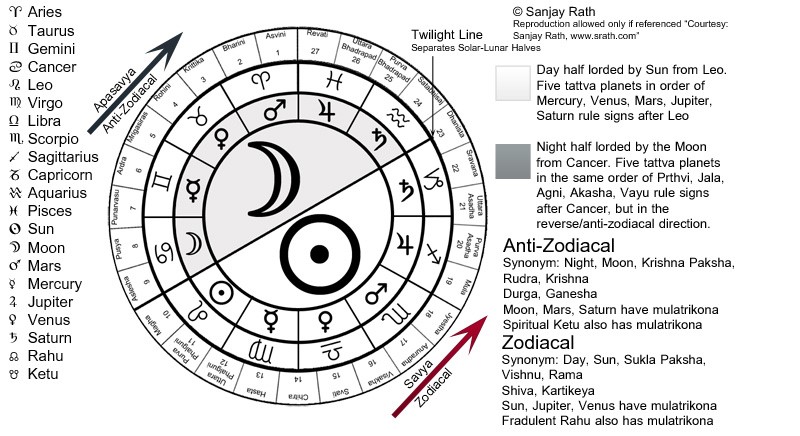
 Gola: गोल (gola) refers to sphere or globe as the celestial globe or as the globe of the sun or of the earth in Sūrya siddhānta. That text also uses the term for a hemisphere (of the earth) when reckoned along the equator. The equator in the bha-chakra is along the East-West axis and passes through the beginning of Aries and Libra.
This is called Chitrā-pakṣa and defines the start of the zodiac at Aries being 180° from the central point of Chitrā nakṣatra. All nakṣatra and consequently the rāśi are reckoned from this starting point which also represents the head of the Kālapuruṣa. This horā refers to Brahma, the creator as the division represents the creation and fixation of the zodiac.
{tab=Symmetry}
Symmetry
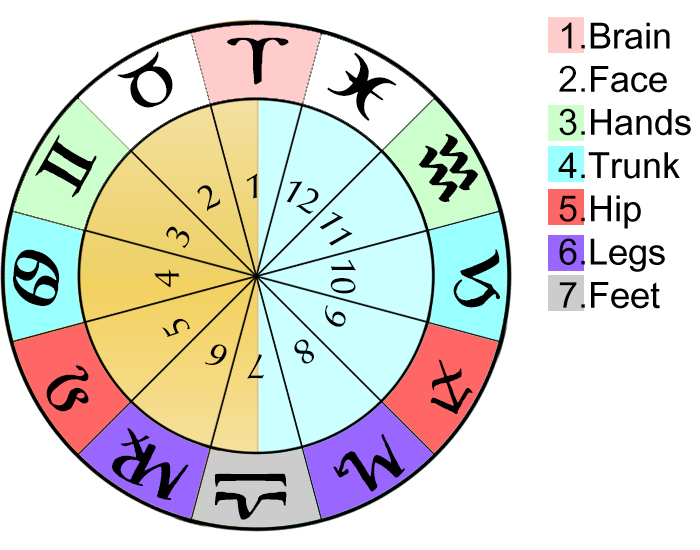
It symbolises the equinoxes in the sāyana chakra (tropical zodiac). The representation of “equal day and night” lengths indicates a symmetry on the two sides which is seen in all creatures where a vertical line from their head to tail symmetrically bifurcates them into two parts. This symmetrical division of the zodiac along the equator has the two hemispheres in the north and south. The northern hemisphere represents the body parts in the right side of the body while the south hemisphere represents the parts in the left side of the body.
- Aries has two halves representing the right and left brain respectively.
- Taurus is the right side of face including the right eye and neck while Pisces is the left side of face, left eye and neck.
- Gemini is the right shoulder and right hand while Aquarius is the left shoulder and left hand.
- Cancer is the right side of the chest and trunk while Capricorn is the left side of the chest and trunk.
- Leo is the right hip and private parts while Sagittarius is the left hip and private parts.
- Virgo is the right leg while Scorpio is the left leg
- Libra has the two feet – first half being the right foot and second half being the left foot.
The next step is to carry this analogy of the Brahma (creator) division into the houses.
- Lagna has two halves representing the right and left brain respectively.
- 2nd house is the right side of face including the right eye and neck while 12th house is the left side of face, left eye and neck.
- 3rd house is the right shoulder and right hand while 11th house is the left shoulder and left hand.
- 4th house is the right side of the chest and trunk while 10th house is the left side of the chest and trunk.
- 5th house is the right hip and private parts while 9th house is the left hip and private parts.
- 6th house is the right leg while 8th house is the left leg
- 7th house has the two feet – first half being the right foot and second half being the left foot.
{tab=Usage}
Application
This is not the standard sign signification of body parts. We have studied the body parts in a previous lesson where the head is in Aries (or Lagna) and feet are in Pisces (or 12th house). This scheme informs us all matters related to balance and symmetry in the body. We can differentiate between the right and left sides of the body. Later we will also learn about another scheme of body parts based on the Moon and the “circulatory system”.
An important application is the study of male and female charts and understanding the first major differentiation made by the creator – Men are from Mars (Aries) and Women are from Venus (Libra). The signs are the mūlatrikoṇa of Mars and Venus respectively. For understanding female chart, we invert the zodiac and place the head in Libra and feet in Aries. Then in an exactly similar manner as we did for male charts, we state –
- Libra has two halves representing the right and left brain respectively.
- Scorpio is the right side of face including the right eye and neck while Virgo is the left side of face, left eye and neck.
- Sagittarius is the right shoulder and right hand while Leo is the left shoulder and left hand.
- Capricorn is the right side of the chest and trunk while Cancer is the left side of the chest and trunk.
- Aquarius is the right hip and private parts while Gemini is the left hip and private parts.
- Pisces is the right leg while Taurus is the left leg
- Aries has the two feet – first half being the right foot and second half being the left foot.
We notice one major difference – the Sun rules the right side of male charts and left side of female charts while the Moon rules left side of male body and right side of female body. There is a very well-known dictum: “Sūrya rules right eye of male and left eye of female while Chandra rules left eye of male and right eye of female.”
| Man from Mars (Aries) | Woman from Venus (Libra) |
| Aries mūlatrikoṇa rules head | Libra mūlatrikoṇa rules head |
| Tendency to short ‘army cut’ hair as Mars ruled agni tattva and the razor | Tendency to long flowing ‘water’ hair as Venus rules jala tattva and cannot cut |
| Think in compartments as Mars demarcates ‘areas’ which are disjointed | Think holistic as Venus connects everything |
| Physical strength ruled by Mars | Biological strength ruled by Venus |
| Strong nerves given by Mars – fighting power; for marriage and home this power must be reduced by Jupiter | Strong emotions (and ojas) given by Venus – nesting power; for marriage and home this power must be increased by Jupiter |
| Systematic, repetitive and ordered as Sun exalts | Unsystematic, non-repetitive and disordered as Sun debilitates |
| Cannot handle pain and sorrow as Saturn debilitates | Very capable of handling pain and sorrow as Saturn exalts |
| Work focus as Sun exalts in 10th (from Aries) | Service focus as Venus exalts in 6th (from Libra) |
| Right hand Self (Su), Left hand spouse (Mo) – so spouse sits on left | Left hand self (Su), Right hand spouse (Mo) – so spouse sits on right |

This is a long list and you can add at least ten more points to the fundamental difference between Man and Woman based on the manner in which Brahma has created the beings.
{tab=Theory}
Āyana-Gola Svastika
 There is a very nice teaching which states “Brahma gives health and longevity (āyus), Viṣṇu gives wealth and fortune (dhanaṁ) and Śiva gives well-being, all relationships, success, fame and every prosperity (kalyāṇaṁ). These are studies from the three horā –Horā Āyana (Viṣṇu), Horā Gola (Brahma) and Horā Guṇa (Śiva).
Āyana Chakra
We are now going to consider the Āyana horā (III) and Gola horā (IV) together. Draw the circle of the zodiac and a horizontal line along Capricorn-Cancer to divide the signs on the basis of uttara and dakṣiṇa āyana. There are six signs on either side. The signs Capricorn to Gemini are said to be ‘north-seeking’ or uttara āyana as they symbolize the sun latitudinal movement from the tropic of Capricorn to the tropic of cancer i.e. latitudinal upward movement. The signs Cancer to Sagittarius are said to be ‘south seeking’ or dakṣiṇa āyana as they symbolize the sun latitudinal movement from the tropic of cancer to the tropic of Capricorn i.e. latitudinal downward movement. When the sun moves upwards, it tends to take the soul upwards to the sapta-loka (seven higher realms of light). When the sun moves downwards, it tends to take the soul downwards to the sapta-tala (seven lower worlds of darkness).
Hari (Viṣṇu) sleeps with head in Abhijit nakṣatra (Capricorn, south) and feet must be in Cancer (north). Such a sleeping posture wins the love of the goddess of fortune Lakṣmī who is his śaktī. In jyotiṣa we recommend that people consider sleeping with their head to the south (and feet to north) thereby copying Viṣṇu and winning the affection of the goddess of fortune and begetting wealth from Kubera. This is the sleeping posture for dhana yoga. Dead bodies are always kept with the head to the north and feet facing south towards Yama. This is sleeping posture for nidhana yoga.
Gola Chakra

Draw the circle of the zodiac and a horizontal line along Aries-Libra axis which is the line of Chitrā-pakṣa ayanāṁśa. We divide the signs on the basis of pūrva (east) and paścima (west) gola. There are six signs on either side. The signs Aries to Virgo are said to be ‘from-east or pūrva gola as they symbolize the sun longitudinal movement called ‘avaroha’ (अवरोह) from its exaltation to its debility. The signs Libra to Pisces are said to be ‘from west’ or paścima gola as they symbolize the sun longitudinal movement called ‘āroha’ (आरोह) from debility (Libra) to exaltation. The two junction points are in the east (pūrva) and west (paścima) unlike the āyana horā where these junction points were are north and south. East symbolises sunrise and also exaltation point of the Sun. when the sun enters Aries, the lights in the heavens get switched on by Indra and stay on till sunset in the west. The important phenomena is the switching on of the light by Indra and even if there is more sunlight at midday, it does not really change the fact that the day has started and the world is visible. For this reason the period from sunrise to sunset, symbolising the daytime, is called pūrva gola (east-hemisphere) or purvārdha (eastern half). At sunset in the west, Varuṇa switches off the lights and the darkness of the night envelopes the heavens. It stays like this till sunrise in the east. This setting out of the light starts in the west and hence the name paścima (west) gola or paścima-ardha (western half).
Now human beings and all creatures are designed by Brahma, the creator, to sleep when the lights go off and awaken when the lights in the heavens are switched on. Sleep begins in the west with Varuṇa and awakening begins in the east with Indra. For good health and longevity one must sleep with the head in the west (and feet to the east). Sleeping in the opposite direction i.e. with head in east and feet to west will bring diseases and suffering.
{tab=Kendra}
The Cross
 Now let us consider the horā-āyana and horā-gola together. We draw the circle of the zodiac and two lines (1) from east to west from Aries to Libra for the horā-gola and (2) from north to south from Cancer to Capricorn for the horā-āyana. This forms the grand vertical cross which symbolises gradual growth and looks like the ‘plus’ sign (+). Gradual growth is beneficial for nature and is the effect of a positive Jupiter with the combined energies of Sun and Moon – all this is sattva guṇa that sustains this planet and the universe.
A fallen cross shows rapid growth as it shows the multiplication (×) with scanty regard for nature. The exploitation of mother earth reaches dangerous proportions threatening to destroy the delicate ecological balance. This is represented by Rāhu with the combined energies of the nodes Rāhu and Ketu – all this is tamas guṇa that destroys this planet and the universe.
There are four quarters of the universe represented with the zodiac caused by the two horā lines of āyana-horā and gola-horā.
- The first quarter (Q1) comprises the first three signs Aries, Taurus and Gemini.
- The second quarter (Q2) comprises the three signs Cancer, Leo and Virgo.
- The third quarter (Q3) comprises the signs Libra, Scorpio and Sagittarius.
- The fourth quarter (Q4) comprises the signs Capricorn, Aquarius and Pisces.
We observe that in Q1 and Q3, when the horā-gola is sun, the horā-āyana is moon and vice versa. This difference between the horā-gola and horā-āyana causes the winds in the bha-chakra to blow in regular direction i.e. in the same direction as the movement of the luminaries Sun and Moon. However, in Q2 and Q4, the horā-gola and horā-āyana are both either ruled by Sun or both ruled by Moon. This causes the bha-chakra winds to blow in the reverse direction i.e. in the direction of movement of the nodes Rāhu and Ketu. Thus, the four graha Sun, Moon, Rāhu and Ketu are critical to all time quality and they indicate regular zodiacal movement or the reverse anti-zodiacal movement respectively. The remaining five graha Mercury, Venus, Mars, Jupiter and Saturn are either moving direct and in the lines of the Sun, Moon (production, creation) or reverse in the lines of the nodes (consumption, destruction).
In simpler words, the six signs in Q1 and Q3 have forward winds and are called viṁśa-pada rāśi (odd footed signs) while the six signs in Q2 and Q4 are called sama-pada rāśi (even footed signs) and have reverse winds.

Sama and Viṁśa Pada Rāśi
trīṇi padā vicakrame viṣṇurgopā adābhyaḥ| ato dharmāṇi dhārayan || Rig Veda
Jyotiṣa Translation: In every three steps in the vi-chakra, Viṣṇu with the gopā and gopī (rāśi signified as male and female attendants) is upholding dharma through an inviolable principle.
These three steps of Viṣṇu are (A) forward movement in Q1: Aries, Taurus, Gemini or Q3: Libra, Scorpio, Sagittarius or (B) reverse movement in Q2: Virgo, Leo, Cancer and Q4: Pisces, Aquarius, Capricorn
Definition: All viṁśa rāśi (odd signs) are also viṁśa-pada rāśi (direct movement) except the fixed Leo and Aquarius which are reverse. Similarly all sama rāśi (even signs) are also sama-pada rāśi (reverse movement) except the fixed Taurus and Scorpio, which are direct.
In this manner we derive the viṁśa-pada and sama-pada rāśi using the horā-gola and horā-āyana.
{tab=Principles}
Svastika: Universal Growth
The movement of the zodiac is either zodiacal or anti-zodiacal depending on the sign holding the power of ‘Nārāyaṇa’ (Nārāyaṇa Daśā). Other means of determination include the tattva and pada of the janma nakṣatra as the winds of change are at the nakṣatra level. They impel thoughts that bring about many changes at all times in the being.
The svastika (Sanskrit स्वस्तिक) is a representation of these winds of change. It has a central cross marking the āyana and gola horā and four outstretched arms at the apex of the cross in the direction of the wind. If the wind is zodiacal then these arms are drawn left and indicate material prosperity given by a stable savya chakra that has balanced growth with change. If the wind is anti-zodiacal then these arms are drawn right and indicate spiritual prosperity given by a stable apasavya chakra.
Stability of the universe (chart) occurs when there are natural benefic planets in kendra houses who are preferably in strength. Natural malefic planets in kendra must be weak to give stability. However, natural malefics in strength and natural benefics being weak show instability and the winds of change start blowing hard. Similarly, planets in other houses also influence the stability on the basis of the manner in which they influence the kendra bhāva.
When the winds of change are very powerful they can cause the world to tilt and life undergoes drastic changes that can translate as very painful life experiences. If the savya chakra tilts and crashes, it causes serious economic downturns, financial crashes, bankruptcy and such negative experiences where the food runs out. It is like a bad Saturn transit in the house of wealth (2nd bhāva) from Moon. On the other hand if the apasavya chakra tilts and crashes due to high winds of change, then it causes spiritual setbacks like moral depravation, addictions, break in the family, separation from near and dear ones and many emotional disturbances that pain the heart for many decades. It is like a bad Saturn transit in the twelfth house (vyaya bhāva) from Moon.

Vāyu Graha
Finally, we now know that we have to keep a keen eye on the winds of change for which we need to dread the ruling planets of vāyu tattva (windy planets) – Saturn and Rāhu. The following show very powerful destructive winds –
- Signs jointly aspected by Saturn and Rāhu
- Signs having pāpakartari yoga of Rāhu and Saturn
- If Rāhu and Saturn are in consecutive signs, then the sign preceding them is where the storm initiates due to severe blockage
- Rāhu and Saturn in mutual quadrants
- Mars and Ketu cause terrible heat waves called Piśāca (a kind of demon) that damages the brain and reason is lost. In general, two or more of the natural malefic planets Rāhu, Saturn, Ketu, Mars and Sun, in that order, can damage a bhāva and initiate the winds of destructive changes.
- Kendra 1, 4, 7, 10: affects childhood
- Paṇapara 2, 5, 8, 11: affects middle age
- Apoklimas 3, 6, 9, 12: affects old age
{tab=Case}
Illustrations

In the chart of Śrī Kṛṣṇa, Rāhu is in 3rd house Cancer and Saturn is in 7th house in Scorpio. Together they damage the 9th house Capricorn with Ketu, the 4th house Leo with ātmakāraka Sun and the 7th house Scorpio with Saturn.
Storm winds in the 4th house affect the babyhood days when Kṛṣṇa had to be transported to foster parents Nanda and Yaśomati immediately after birth. There were various attempts on his life by various demons but he always emerged successful in demolishing them as Moon, the kāraka for the 4th house, is very strong in lagna. Further, Sun in 4th house is flanked by many planets in the 3rd and 5th houses making one a great warrior and very strong physically, like a boxer. Kṛṣṇa was known as a great wrestler and gave tips to Bhīma and other such fighters.
Storm in the 7th house is in Abhijit rāśi, which is the 4th rāśi from the Sun. It houses the 9th lord Saturn in digbala. Viṣṇu avatāra always have the ninth lord of dharma in digbala, exaltation and such strengths signifying their purpose of incarnation. Similarly the storm in the 9th house is in dharma bhāva. The Lord incarnates when there is a storm threatening to destroy dharma completely. These signs Scorpio and Capricorn having the storms are actually transferring the entire storm to Sagittarius as they have pāpakartari yoga on Sagittarius, the battle field. Further, Saturn and Ketu are in parivartana yoga. We have learnt earlier about this yoga when two planets exchange signs, they behave like they are in their own signs, and yet in the houses and are interlinked strongly. Saturn is as if in own sign Capricorn in 7th house in digbala while Ketu is as if in Scorpio in the 9th house. There is yet another exchange (parivartana yoga) between Moon and Venus exactly balancing the effects of Saturn and Ketu being in opposite signs from this parivartana. The two storms transferring to Sagittarius indicates the great battle – Mahabharata.
When will this happen? Essentially this fight happens throughout life but culminates at certain times. Since this is a very peculiar combination where the two signs having the storms are ‘compressing’ into one sign due to pāpakartari yoga – this culmination happens when the pakṣa compression occurs. Śrī Vedavyāsa writes in the Mahābhārata (Book 6. Bhīśma Parva)
इमां तु नाभिजानामि अमावास्यां त्रयोदशीम्॥ २८॥
चन्द्रसूर्यावुभौ ग्रस्तावेकमासे त्रयोदशीम्।
अपर्वणि ग्रहावेतौ प्रजाः सङ्क्षपयिष्यतः॥ २९॥
caturdaśīṁ pañcadaśīṁ bhūtapūrvāṁ ca ṣoḍaśīm |
imāṁ tu nābhijānāmi amāvāsyāṁ trayodaśīm || 28||
candrasūryāvubhau grastāvekamāse trayodaśīm |
aparvaṇi grahāvetau prajāḥ saṅkṣapayiṣyataḥ || 29||
Translation: We have seen the well-established [pakṣa] of 15 days stretch to 14 days or 16 days. But we had never seen the amāvāsya in the 13th day. And that too the month has both the Sun and Moon eclipses with one occurring on the 13th day amāvāsya. Such a terrible combination falling on the missing tithi spells doom and large scale disaster to people.
The timing of this deadly pāpakartari yoga involving Rāhu and Saturn and the signs Scorpio and Capricorn had been predicted by Lord Kṛṣṇa –
“Rāhu has compressed pūrṇa (pūrṇimā or amāvāsya, 15th tithi) on caturdaśī (14 tithi). A previous occurrence of this was before the Mahabharata war and will be happening again soon. This will lead to our destruction”.
Pāpakartari yoga caused by malefic planets shows compression of some sort and this is timed by the compression of the pakṣa with respect to the vāra. This prediction came true and while a large portion of the Yadava army was destroyed in the Mahābhārata, the entire city of Dwarka went under the ocean after Kṛṣṇa departed – timed with the compression of tithi.
We learn more details about the Pañcāṅga and Tithi compression as well as vanishing tithi and dirty months (mala māsa) later when we arrive at daśā and timing.
Past and Future
To know the past and future of any person this concept of the svāstika is made use of which employs the gola horā in the first place to group people as born with Lagna in the Sun (Aries to Virgo) or Moon (Libra to Pisces). Thereafter, it uses the āyana-horā bhāva as (a) External or Sun horā from houses 4th to 10th via 7th house or (b) Internal or Moon horā from houses 10th to 4th via Lagna. This entire process is explained in the jyotiṣa classic Praśna Mārga under Chapter titled ‘Bright and Dark Future’.

If Lagna is in the signs Libra to Pisces [Moon gola-horā], then
Śloka 8: The ‘future’ of the person will be bright or dark according as the six houses from the latter part of the 4th house [Sun, External āyana-horā) are occupied by benefics or malefics.
Śloka 9: If the six houses from the latter portion of the 10th house [Moon, Internal āyana-horā] are occupied by benefic or malefic planets, then the past life of the person would have been fortunate or otherwise. This applies to persons born in the six rāśi counted from Libra.
If Lagna is in the signs Aries to Virgo [Sun gola-horā] Śloka 10: For persons born in the six rāśi beginning with Aries, past is indicated by the houses 4 to 10 [Sun, External āyana-horā] and the future by houses 10 to 4 [Moon, Internal āyana-horā].
Note that the unexpired portion of 4th house till the expired portion of the 10th house i.e. cusp of 4th house to cusp of 10th house via 7th house is the Sun (external) āyana-horā. Benefics indicate good results while malefics signify misfortunes and strife. This is extremely important as it shows how relationships sour and rājayoga or any sambandha can break.
We have shown the roots of many concepts in vedic astrology. In time you will learn to use them skillfully. Unless you take time to understand these derivations and concepts, the knowledge they contain and the tools they represent will be of no avail.
{tab=Video}
Gola Horā
Gola Horā Presentation
- Please be patient as the slides can take a little time to download
- Make copious notes
- Ask Questions at Forums of this website
{/tabs}