Guṇa: refers to the nature of signs and planets as of one of the three types – sattva, rajas or tamas.
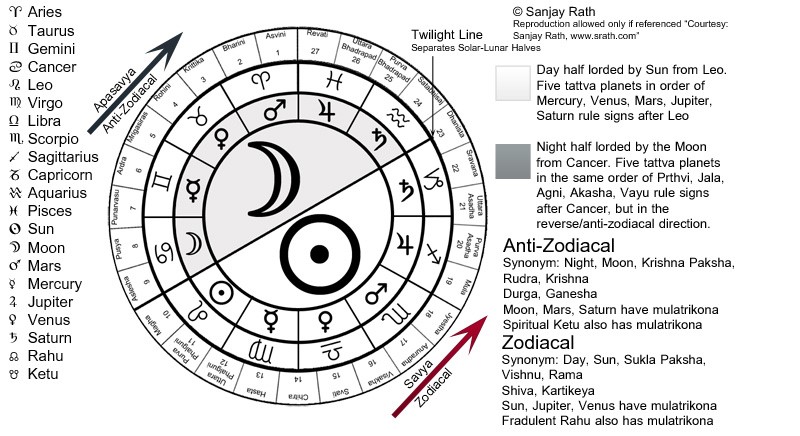
An imaginary line divides the zodiac into two halves as it passes through the 0° Leo and Aquarius Half or Horā is derived from the word Aho-Rātra (Aho means day and Rātra means night) indicating the two-fold divisions of the day into equal halves of light and darkness. Thus, this division of the zodiac was into the two parts called Solar and Lunar halves or Surya Horā and Chandra Horā respectively.
द्वादश चक्रं भगणास्त्स्यास्यर्धे सिंहतो रविर्नाथः।
कर्कटकात् प्रतिलोमं शशी तथान्येऽपि तत्स्थानात्॥
dvādaśa cakraṁ bhagaṇāstsyāsyardhe siṁhato ravirnāthaḥ|
karkaṭakāt pratilomaṁ śaśī tathānye’pi tatsthānāt||
Translation: The solar half or Surya Horā includes the six signs in the zodiacal order from Leo to Capricorn and the lunar half or Chandra Horā includes the six signs from Cancer to Aquarius reckoned in the reverse order. Sun lords the solar half from Leo while the Moon lords the lunar half from Cancer.
Lordship derivation
This division has nothing to do with Ayana. The Sun and Moon own adjoining signs (i.e. Leo & Cancer respectively) in their Horā (zodiacal halves) and these seats are in the North, facing south. From this we learn that south facing seats are for those in power and having a position of authority.
The five tattva planets in the order of Mercury (pṛthvi), Venus (jala), Mars (agni), Jupiter (ākāśa) and Saturn (vāyu), based on their geographical distances from the Sun [i.e. Mercury is closest and Saturn is the most distant] shall own the signs in their proximity to Leo and Cancer reckoned in the zodiacal or reverse order respectively (see figure). This horā is completely based on (1) physical directions (2) distance of planets. Day half lorded by Sun from Leo. Five tattva planets in order of Mercury, Venus, Mars, Jupiter, and Saturn rule signs after Leo. Night half lorded by the Moon from Cancer. Five tattva planets in the same order of Pṛthvi, Jala, Agni, Ākāśa and Vāyu rule signs from Cancer, but in the reverse/anti-zodiacal direction. However, this is not the order of the tattva cycle. We derive it later on. This horā division along Leo-Aquarius axis –
- derives the lordship of signs reckoned from North (luminaries) to South (Saturn) and others in between.
- We also learn that the Sun tends to move everything in the zodiacal order while the Moon tends to move things in the anti-zodiacal order.
- Zodiac North comprises two signs Cancer and Leo where the energy is moving these signs towards each other while Zodiac South comprises Aquarius and Capricorn where the energy is moving these signs away from each other. Consequently the Sun and Moon tend to bring things together while Saturn makes things move apart and break away.
- Mars and Venus lord the signs in the Zodiac East (Ar, Ta) and Zodiac West (Li, Sc).
- The intermediate directions are ruled by Mercury and Jupiter
Savya and Apasavya
The word ‘pratiloma’ means against the hair or grain as opposed to ‘anuloma’ which is for the Sun. It implies going contrary to the natural course or order, reverse, inverted as turning to the left and not right. This is the first differentiation in Vedic astrology where we learn to see things as black and white – white is for the sun referring to the day and black is for the Moon referring to the night.
The two words सव्य (savya) meaning zodiacal, regular and अपसव्य (apasavya) meaning anti-zodiacal, left-handed or reverse comes from this division of day and night.
It is contrary to caste (where the mother is of a higher caste than the father). Among mantra it refers to a particular kind of incantation recited from the end to the beginning instead of beginning to end.
It indicates anything that is born inverted or in inverted order or series.
Day and Night Strong
Jyotiṣa Principle: Day or night strong planets are determined on the basis of the placement of their mūlatrikoṇa signs in the savya (Sun) horā or apasavya (Moon) horā. For the nodes, their svakṣetra (home) is used instead of mūlatrikoṇa (office) as taught in Nārāyaṇa daśā.
- Sun has mūlatrikoṇa in Leo, the start of the savya horā, and is day strong
- Moon has mūlatrikoṇa in Cancer, the start of apasavya horā, and is night strong
- Mars has mūlatrikoṇa in Aries, in apasavya horā, and is night strong
- Mercury has mūlatrikoṇa in Virgo, in savya horā, and is day strong. However due to its strong dual nature, it is considered both day and night strong.
- Jupiter has mūlatrikoṇa in Sagittarius, in savya horā, and is day strong
- Venus has mūlatrikoṇa in Libra, in savya horā, and is day strong
- Saturn has mūlatrikoṇa in Aquarius, the end of apasavya horā, and is night strong
- Rāhu has svakṣetra in Aquarius, in apasavya horā, and is night strong
- Ketu has svakṣetra in Scorpio, in savya horā, and is day strong
We may note that Rāhu mūlatrikoṇa in Virgo is in savya horā, which is day strong indicating that the highest untruth, māyā of saṁsāra (worldly existence) is apparent during the day time where the motion of the Sun makes us believe that it rises in east and sets in the west, retrograding through the zodiac. Such a big lie is visible to the naked eye everyday of our existence in this planet and we actually take this as the visible truth. Yet we know through science that the Sun never retrogrades and cannot move from east to west in the anti-zodiacal fashion. Therefore Hindu philosophy has saṅnyāsa where the untruth of saṁsāra is rejected and the world is renounced so that in our hearts we may seek the highest truth. Saṅnyāsa is the only means to remove Rāhu (untruth) completely from life.
Ketu mūlatrikoṇa in Pisces is in apasavya horā , which is night strong indicating that the highest meditations are done during the night. All spiritual activity like going to temple and listening to discourses is done during the day while the night meditations lead to mokṣa.
Planets in Horā
भानोरर्धे विहगैः शूरास्तेजस्विनश्च साहसिकाः।
शशिनो मृदवःसौम्याः सौभाग्ययुताः प्रजायन्ते॥
bhānorardhe vihagaiḥ śūrāstejasvinaśca sāhasiakāḥ|
śaśino mṛdavaḥsaumyāḥ saubhāgyayutāḥ prajāyante||
Translation: Planets (vihaga) placed in the solar half are (a) strong, valiant, heroic (b) enegitic and (c) very brave while those in lunar half (a) have contrasts of merit and demerit, (b) amicable disposition, and (c) good fortune.
Kalyāṇavermā teaches us to view two placements simultaneously –
- Placement in the rāśi chart in the solar half (Leo-Capricorn) or lunar half (Cancer-Aquarius) as a starting point to determine the aggressive, strong, energitic, brave Sun like disposition or passive, amicable, fortunate Moon like nature
- Placement in the Sun or Moon horā of the sign to enhance the same qualities or have a more balanced personality.
Kalyāṇavermā has focused on the placement of the lagna itself as the first step. For example see the chief warriors of World War II who were all born in signs in the solar half from Leo to Capricorn. On the left hand we had Adolf Hitler (Libra Lagna), Benito Mussolini (Libra or Scorpio Lagna) and Emperor Hirohito (Scorpio Lagna). On the right hand we had F.D.Roosevelt (Leo Lagna), Sir Winston Churchill (Virgo Lagna) and Joseph Stalin (Sagittarius Lagna?).
Guṇa Exaltation
Sattva Guṇa planets Jupiter, Sun and Moon exalt in the signs Cancer, Taurus and Aries which are in the Moon horā.
Tamas Guṇa planets Mars and Saturn exalt in Capricorn and Libra which are in the Sun horā.
Rajas guṇa planets Venus exalts in Pisces in Moon horā whereas Mercury exalts in Virgo in the Sun horā. Rajas tilts between Sattva and Tamas guṇa. If Mercury is stronger than Venus then the rajas in the chart moves towards tamas guṇa whereas if Venus is stronger than Mercury, then the rajas moves towards sattva.
All beings are created by Brahma and their minds are with rajas guṇa and will constantly move towards sattva and tamas as the time passes due to daśā and karma recorded through the navagraha in their charts. The tendency to move towards sattva is seen from lagna in moon horā and/or Venus stronger than Mercury whereas in the converse – lagna in sun horā or Mercury dominating the Venus, the tendency is to move towards sattva guṇa. Yet the real pull towards the sattva guṇa are from the other sattva planets while the tamas guṇa planets pull towards tamas guṇa.
It is interesting to note that the most diabolical Rāhu is exalted in Gemini (and Taurus for longevity) which are in the sattva guṇa moon horā. It shows the power of Rāhu to destroy your sattva guṇa. In destroying the sattva of the Sun, Rāhu destroys legitimate wealth and brings deadly poverty. In destroying the sattva of the Moon Rāhu brings insanity and deadly diseases. In destroying the sattva of jīva-kāraka Jupiter, Rāhu brings mṛtyu (and apamṛtyu). Similarly Ketu is exalted in Sagittarius (and Leo for longevity) which shows its power to destroy tamas guṇa. This power to destroy is actually tamas guṇa itself and therefore these graha have the energy or Rudra and are tamas guṇa by themselves as they are hell bent on destroying something. By destroying darkness Ketu actually opens the doors of mokṣa and therefore is important graha in the paraṁparā yoga (Ketu + Guru) as it is important to overcome vices (Mars) and sins (Saturn) to proceed in the spiritual path.