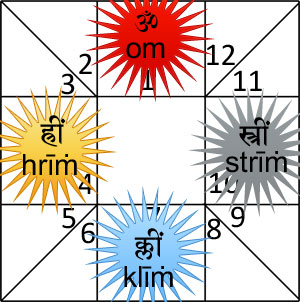
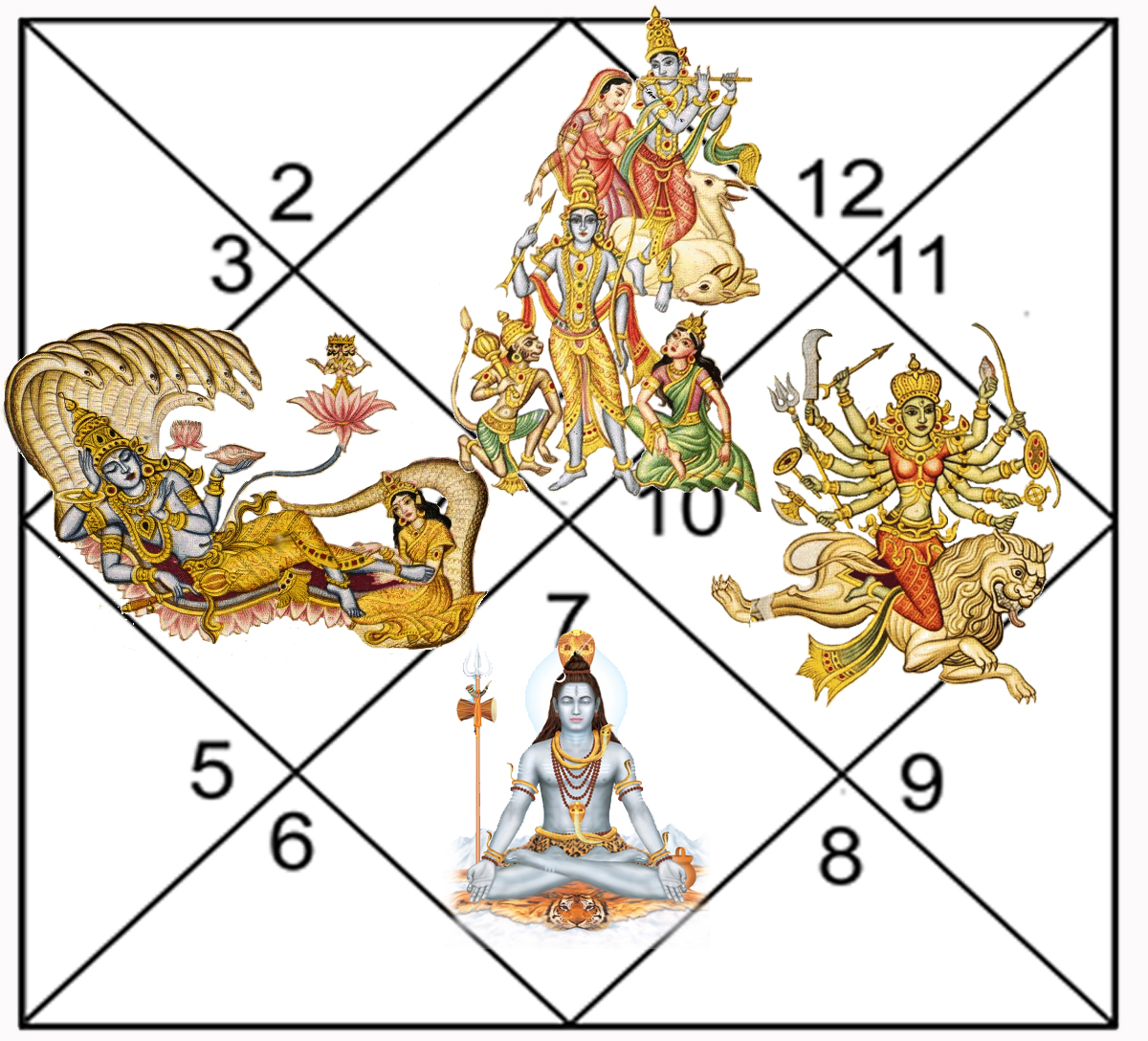
The word kendra (Sanskrit. केन्द्र) means that which is the center of something like a focus. As explained earlier, the concept of kendra was derived from the lunar tides and extended to the other planets. It was applied to the equinoxes at Aries-Libra and solstices at Cancer-Capricorn, which form the grand cross of the zodiac. The kendra form the grand cross and include the first, fourth, seventh, and tenth houses or nakṣatra.
Apsis
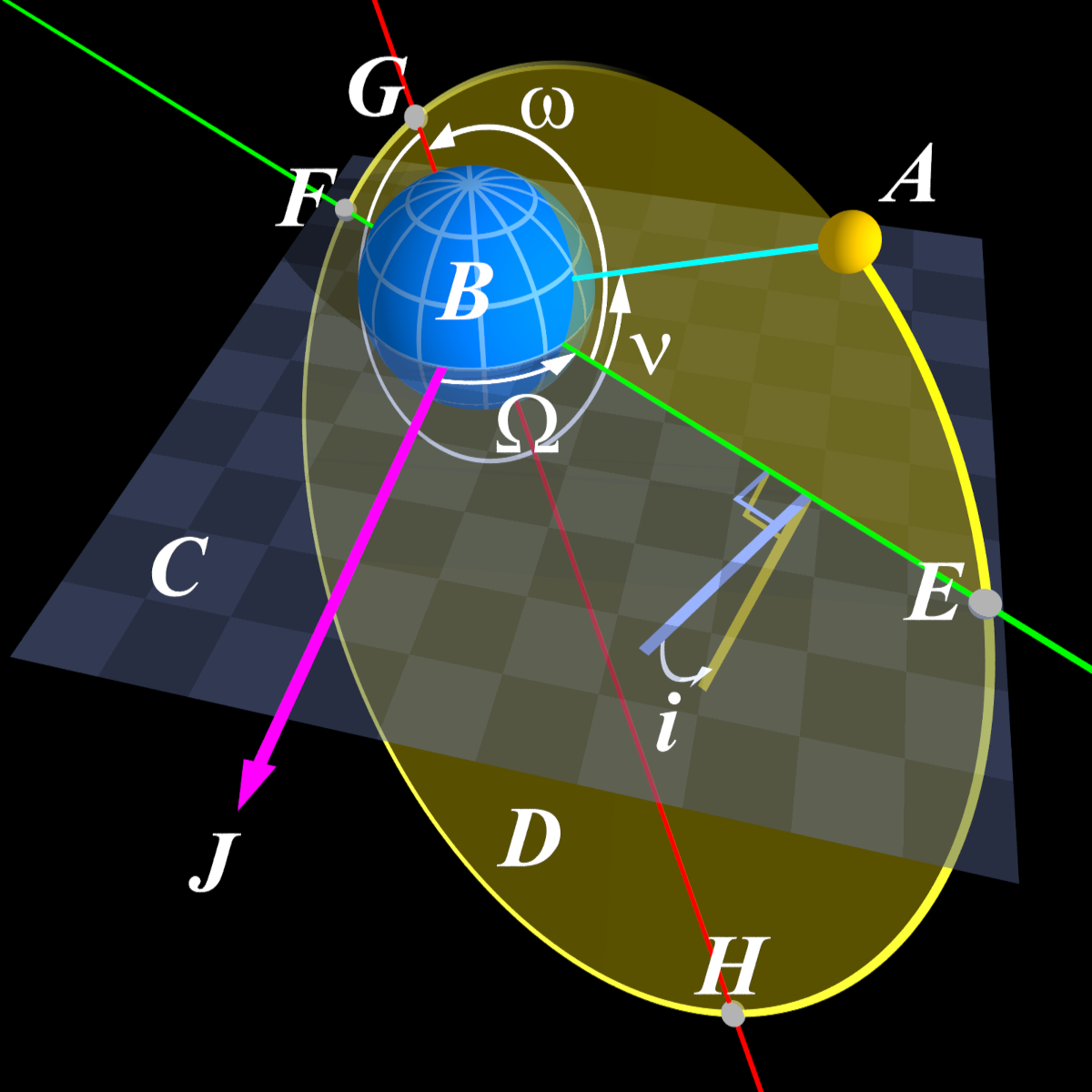
An apsis, plural apsides, is the point of greatest or least distance of a body from one of the foci of its elliptical orbit. In modern celestial mechanics this focus is also the center of attraction, which is usually the center of mass of the system. Historically, in geocentric systems, apsides were measured from the center of the Earth. The point of closest approach (the point at which two bodies are the closest) is called the periapsis or pericentre, from Greek peri, around, and kentron. The point of farthest excursion is called the apoapsis, apocentre or apapsis. The latter term, although etymologically more correct, is much less used. A straight line drawn through the periapsis and apoapsis is the line of apsides. This is the major axis of the ellipse, the line through the longest part of the ellipse. Derivative terms are used to identify the body being orbited. The most common are perigee and apogee referring to orbits around the Earth, and perihelion and aphelion referring to orbits around the Sun (Greek hēlios, “sun”).
Terminology
The words “pericenter” and “apocenter” are occasionally seen, although periapsis/apoapsis are preferred in technical usage.
Various related terms are used for other celestial objects. The ‘-gee’, ‘-helion’ and ‘-astron’ and ‘-galacticon’ forms are frequently used in the astronomical literature, while the other listed forms are occasionally used, although ‘-saturnium’ has very rarely been used in the last 50 years. The ‘-gee’ form is commonly (although incorrectly) used as a generic ‘closest approach to planet’ term instead of specifically applying to the Earth.
| Body | Closest approach | Farthest approach |
| General | Periapsis/Pericentre | Apoapsis |
| Sun | Perihelion | Aphelion |
| Mercury | Perihermion | Apohermion |
| Venus | Pericytherion/ Pericytherean/ Perikrition | Apocytherion/ Apocytherean/ Apokrition |
| Earth | Perigee | Apogee |
| Moon | Periselene/ Pericynthion/ Perilune | Aposelene/ Apocynthion/ Apolune |
| Mars | Periareion | Apoareion |
| Jupiter | Perizene/ Perijove | Apozene/ Apojove |
| Saturn | Perikrone/ Perisaturnium | Apokrone/ Aposaturnium |
Although most people use the words Aphelion/Perihelion for earth-sun distance and Apogee/Perigee for earth-moon distance.
Jyotiṣa terminology

Jyotiṣa literature has words like dvitīya kendra referring to ‘second’ or ‘second set’ of quadrants and implying that there is a prathama kendra (first or first set of quadrants). In terms of houses, the first is called ‘prathama kendra’, the fourth house will be dvitīya kendra, seventh house will be tritīya (third) kendra and tenth house will be caturtha (fourth) kendra. However kendra bhāva can be reckoned not only from the lagna but also from the planets. Then the nomenclature will be based on speed of the body. The lagna kendra (quadrant houses from ascendant) are called prathama kendra, quadrants from the Moon dvitīya kendra and so on.
Udaya Kendra
The kendra houses are also given specific names based on the effect of the Sun. When the Sun is in the ascendant sunrise occurs and therefore the first house (lagna) is called udaya kendra where udaya (उदय) means rise like the sunrise.
Asta Kendra
The opposite happens at sunset when the Sun is in the 7th house. Therefore the seventh house is called asta (अस्त) kendra where aṣṭa means (1) at home, (2) setting (as of the sun or of luminaries) (3) end, death as vanishing from sight which happens to the sun at sunset (4) the western mountain of Varuṇa (behind which the sun is supposed to set) and (4) in astronomy/astrology the seventh mansion.
The word अस्ताङ्गत (astāṅgata) is derived from this setting time of the Sun in the 7th house and has been loosely translated as combustion of a planet. However this is a situation which happens to all planets including the luminaries. At some stage in their continued existence they vanish from the sky and this is referred to as their burning out like lamps burn out when the oil runs out. All season planets (Moon-Saturn symbolise the six seasons) suffer astāṅgata (combustion or vanish) when they are close to the Sun. It implies that these six season planets have ‘maximum light’ when they are opposite the Sun. However the Sun suffers astāṅgata when in the 7th house. And we know that Rāhu is given the charge of eclipsing the Sun which is akin to astāṅgata although it is for a short phase. Therefore, Rāhu has its maximum potency in the 7th house (digbala) and symbolizes sunset and sunset like sunrise is a node or turning point of the day when the day becomes night and vice-versa. Contrary to this Ketu will represent the other node of the day which is the sunrise.
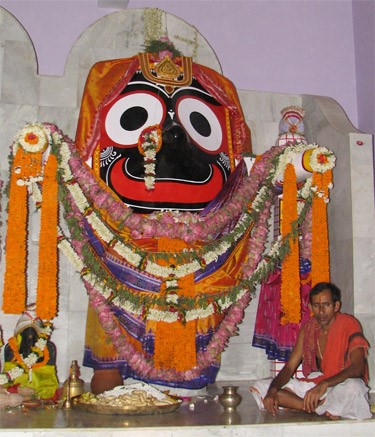
Astāṅgata is hibernation, sleep or meditation stage of a planet when it suffers spiritual cleansing. It refers to a stage which is akin to the Sun in 7th house, undergoing the phase of sunset. In the natural zodiac this is the sign Libra, the sign of fall of the Sun and hence it is called patana (पतन) kendra where patana means fall, dying out, decline, ruin and death. It is a situation where all ego, self-esteem or even self-respect has died within and a very humble soul seeks solace. It is easy to understand as to why Saturn the planet of death, destruction and ruin is exalted in Libra, or has digbala in the 7th house where the Sun suffers patana. Definition of god derives from this point as ‘पतित पावन’ (patita pāvana) or He who lifts the fallen souls. And this is the exact name with which the people of Puri worship Jagannāth. At this worship Jagannāth is alone without siblings, family etc. It shows the loneliness of the fallen soul and in his humility and having completely forsaken everything that can cause the ego, the soul attains the feet of Jagannāth. It maybe noted that the vision (dṛṣṭi) of a fallen planet is on the sign of its exaltation and therefore exalted planets represent Viṣṇu avatāra.
Ākāśa or Svarga Kendra
At mid-day the Sun is in the 10th house which is referred to as ākāśa (sky) kendra, the throne of the sky-father. The sun glows with maximum light and therefore this tenth house is called svarga (heaven) kendra as the heavens are full of light. This house becomes the digbala (directional strength) of the Sun due to its ability to have the Sun shine in its greatest glory. The Sun governs the world (karma-kṣetra) with the aid of the ten digpāla (directional deities) and gives karmic fruits from the śaktī (spouse) of the digpāla. Note that there are ’10’ digpāla and this svarga refers to the ‘10’ house. This house guides through sight or vision.
Jala or Narka Kendra
At midnight the Sun is in the 4th house which is referred to as narka (नर्क) derived from न अर्क (na arka) meaning ‘no-sun’ and also the ‘nose’ which although so close to the eye, remains invisible. Thus, the 4th house is called narka kendra and guides through smell. The word क (ka) refers to Brahma the creator of physical bodies and अर्क (arka) refers to the rays of the Sun which gives form to everything. Putting the two together we get कर्क (karka) which is Cancer, the 4th sign of the natural zodiac and means ‘water vessel’ like ponds and rivers, white horses, crab, mirror, beauty as seen by the mind and the youngest of the family who is always in the arms of the mother. This fourth house is also called Jala Kendra the throne of the earth-mother who cradles and nourishes. Remember ‘If 10th is arka, then 4th is karka’.
Kendra Colors

Esoteric colors of the four kendra are Red (Lagna), Black (4H), Blue (7H) and Yellow (10H). These are the colors of the sky at dawn, midday, dusk and midnight respectively. However, all this is our perception as the Sun is actually static and what is moving is the lagna. This causes the 4th-10th houses to be inverted in terms of energy and the Yellow Sun is in 4th house while Black Sun is in 10th house. This reality of sky colors referred to as the four sun’s are –
- Red Sun: Brahma, Āditya
- Yellow Sun: Durgā, Śaktī
- Blue Sun: Rama, Kṛṣṇa
- Black Sun: Rudra, Kāla
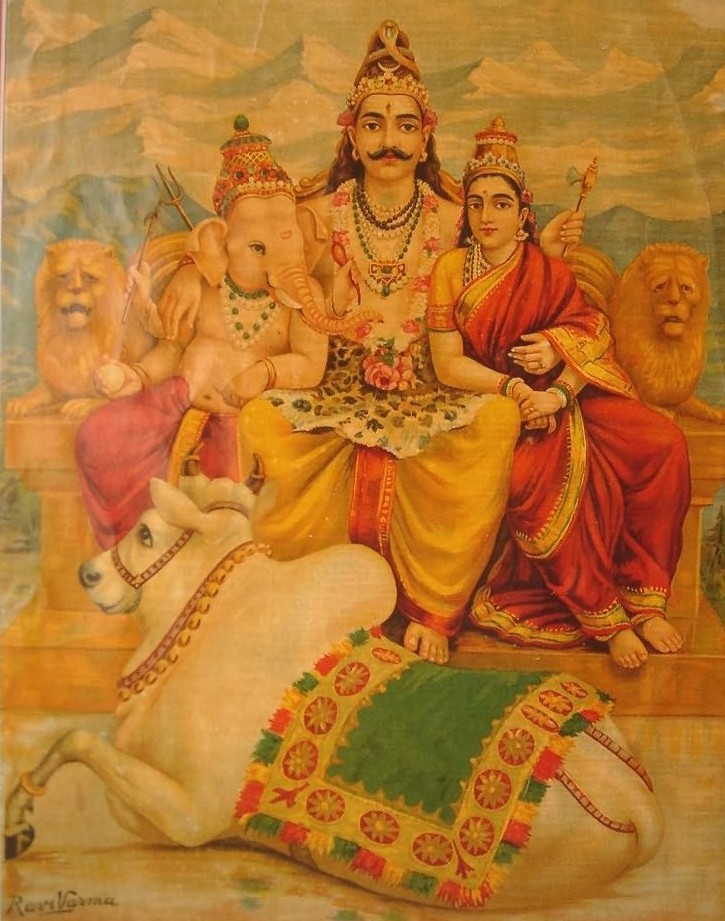
From the Vaiṣṇava perspective, Red Sun is Narasiṁha, Yellow Sun is Rama, Blue Sun is Kṛṣṇa and Black Sun is Varāha – the four principal pūrṇa avatāra. From a Śaiva perspective, Red Sun is Gaṇeśa, Yellow Sun is Gourī (Durgā), Blue Sun is Kārtikeya and Black Sun is Rudra. Śiva is the pure white light and hence, the white Sun. One must remember these principal and opposing colors of the kendra and devatā.
Consider the United States: (1) the two main colors in the flag are red and blue, and (2) the colors of the two principal political parties are red (republicans) and blue (democrats). This is the Aries-Libra or 1st-7th house axis. This axis must play a strong role in the chart of the United States. See chart –
Jupiter the lord of the first house is in the seventh house bringing into play these two kendra colors – red and blue, that are always fighting for dominance over the destiny of the nation. Kendra having planets become very strong and can override the effects of daśā and transits – see Viṣṇu sthāna below.
Exact Svarga and Narka
For the orbit of the Earth around the sun, the time of apsis is often expressed in terms of a time relative to seasons, since this determines the contribution of the elliptical orbit to seasonal variations. The variation of the seasons is primarily controlled by the annual cycle of the elevation angle of the sun, which is a result of the tilt of the axis of the Earth measured from the plane of the ecliptic. Currently, the annual perihelion happens at about 14 days after the Winter Solstice, thus on or about January 4. The eccentricity of the orbit also varies slowly over many millennia. Likewise, the annual aphelion currently occurs in early July, about 14 days after the Summer Solstice. On a very long time scale, the dates of the perihelion and of the aphelion progress through the seasons, and they make one complete cycle in 22,000 to 26,000 years. There is a corresponding movement of the position of the stars as seen from Earth that is called the apsidal precession. This is not the precession of the axis (ayanāṁśa).
The summer and winter solstices are related to the seasons and the tropical zodiac (sāyana chakra). We can convert this to the sidereal zodiac (niryāna chakra) for jyotiṣa purposes. Winter solstice is equated to makara saṅkrānti (presently about Jan 14 when Sun enters sidereal Capricorn) and the perihelion point which is about 14 days (14°) ahead is at about 14° Capricorn in the nakṣatra called Śravaṇa. This is an approximation and the calculation should bring us very close to the Abhijit nakṣatra, the throne of the heaven which shows the Sun in the exact 10th house of the natural zodiac throwing the highest light in our universe. This is Abhijit nakṣatra in the Svarga of the natural zodiac and is at about 10° Capricorn. The opposite point at 10° Cancer is Narka. Reckoned from Aśvinī, Abhijit is the 22nd nakṣatra while Tiṣya (Puṣyā) is the 8th nakṣatra. This 22nd nakṣatra is the undefeated one and has the power to defeat and destroy everything – it is called ‘Vaināśika Nakṣatra’ from vināśa (m. utter loss, annihilation, perdition, destruction, decay, death, removal) and god alone can save us from these karmic fruits (punishment) that the heavens shower on us as the sky-father leads the Pitṛs (jyotiṣa: pitṛ kāraka). A midday prayer removes the punishment of poverty and such ills. Tiṣya is a fruitful and nourishing nakṣatra and the earth-mother with the Mātṛs (jyotiṣa: mātṛ-kāraka) cradles us when we are like babies enjoying her bread.
Viṣṇu – Lakṣmī Sthāna
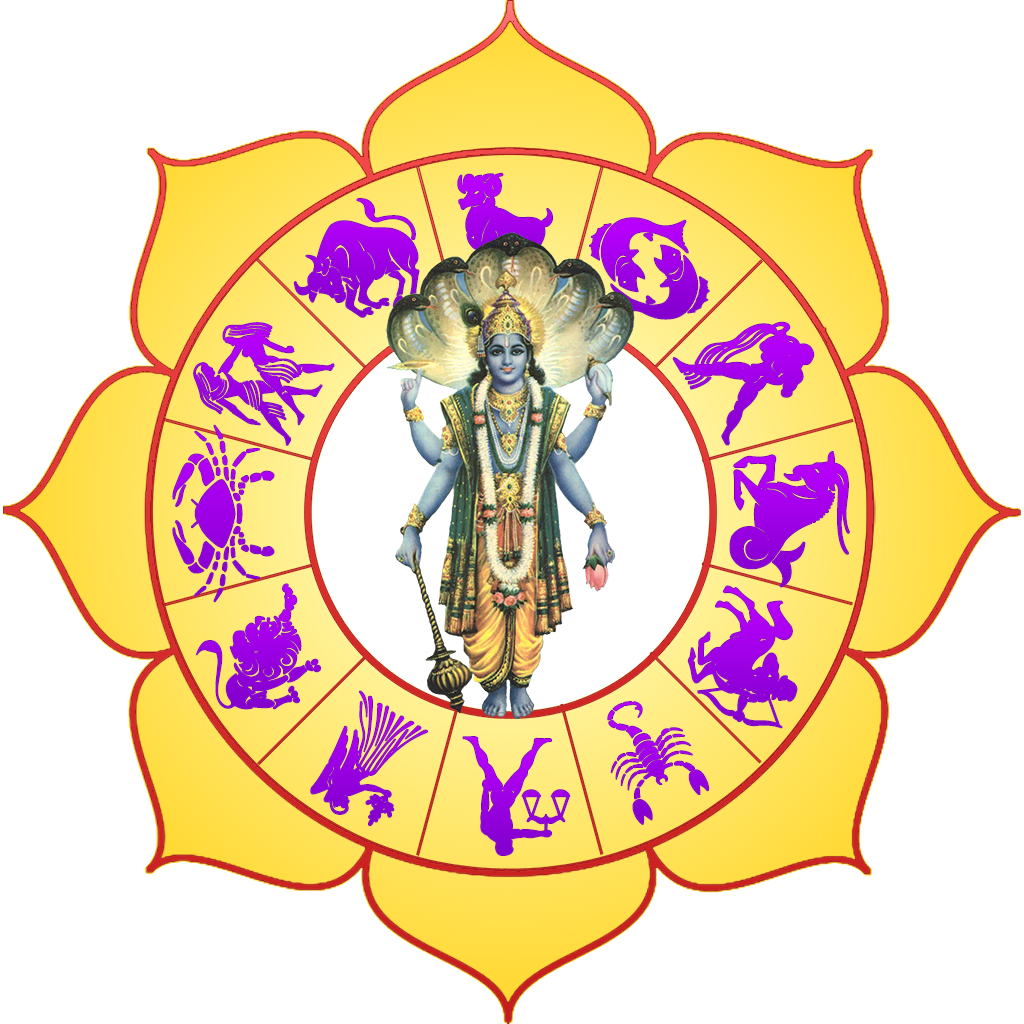
The word Viṣṇu means sarva-vyāpaka or spreading everywhere – omnipresent like the ākāśa tattva. And Parāśara later refers to kendra as Viṣṇu sthāna or the points from where the influence spreads very strongly. This spreading happens into the koṇa (trines) which are the Lakṣmī sthāna and Lakṣmī is the spouse (śaktī, power) of Viṣṇu. Let us understand this in jyotiṣa terms. If a planet is in the 10th house, it attains a kendra and its influence shall spread into the trines to the kendra it is placed it. In this case these are 2nd and 6th houses. Therefore a planet in the 10th house actually ends up controlling or having an overbearing power over the planets in the 2nd or 6th houses. The planet in the kendra becomes like Vāsudeva (Viṣṇu) and the trines to it represent Śrī Śaktī (5th) and Bhū śaktī (9th) who carry its influence into the trines. For example, if Mercury is in 10th house, Jupiter in 2nd house and Saturn in 6th house, then Mercury shall have overbearing power over both Jupiter and Saturn.
Kendra Power
Kendra are power centers which radiate their control into the trines. Since the ākāśa tattva permeates through the kendra the formation of nabhas yoga (sky-yoga) shows the predominant nature of the ākāśa tattva. We study nabhas-yoga in the future. Suffice is to know that planets in kendra to lagna tend to control the destiny of the native dominating over the results given by the daśā from the Moon (mind). Implication is that the desires and plans do not work and these graha tend to push their own agenda. If they are malefic planets, then being weak indicates success whereas strong benefics are a blessing.

In the example of United States chart, there are five planets in kendra indicating tremendous push and control over its destiny. Further, they are in a peculiar formation covering only two successive kendra – 7th and 10th houses. This is an incomplete nabhas yoga in that all seven planets from Sun to Saturn are not in these houses. We must use the Garga Muni upadeśa that “during kali yuga (present age) it is impossible for the perfect combinations to be formed”. Consequently we have to accept the formation of yoga if two or more planets complete the requisite combination. In this case five of the seven planets form the गदा योग (gadā yoga where gadā means ‘mace’).
Results of Gadā yoga
- Will endeavor to earn wealth and will be constantly concerned about money matters – true as the United States went on to become the richest nation in the world and is constantly discussing its finances, debts and economic scenario.
- will perform sacrificial rites – people of the United States are very open to all kinds of spiritual teaching and are strongly involved in spiritual practices, especially since the 9th lord is also in 7th house involved in the gadā yoga.
- Skilled in Śāstra – scientific study, research and development is the hallmark of the US producing the largest number of Nobel laureates.
- Expert in songs and music – two things that mark the strong influence of its culture are its music which dominates the world and Coca Cola!
- Endowed with wealth, gold, and precious stones – extremely resourceful and always exploiting the natural resources for production purposes.