We must not forget that it was the Hindus who discovered what is known as the precession of the Equinoxes, and in their calculation such an occurrence takes place every 25,827 years. Our modern science, after labors of hundreds of years has simply proved them to be correct. …Count Viscount Cheiro
{tab=Time and Space}
Time and Space
Time and space are like endless rings without a beginning and without an end. The definition of the beginning of a linear time scale or the starting point of the Universe has been the vexed question of many a thinker and this thought leads the mind to a definition of God as being imperceptible. The great Vedic thinkers personified God as KalaPuruṣa1 and harmonized these two concepts of time and space into the four-dimensional model of Bhachakra (geocentric zodiac). Normally the Bhachakra is represented as a two dimensional figure for easy reading on paper, but the other dimensions of a dynamic linear time and the vertical declination of the planets were also examined and noted. Thus, the first and foremost point to bear in mind is that every division of the zodiac has a similar or matching division of time. As we study each of the divisions, we will also examine the time measure represented by it and will get additional clues to interpret results and delineate the effect of time on the division.
{tab=Rāśi}
The division of the zodiac into twelve signs and twenty seven (or twenty eight Nakshatra) is the primary division in the paradigm of Vedic Astrology. Every now and then a new planet is seen and the doubts arise in the minds of the learned on the continued validity of the twelve sign zodiac. To clear these doubts, it is necessary to understand the basis of this primary division called Rāśi. The zodiac of 12 signs and 27 constellations was prepared by carefully observing the movement of the Sun and Moon in the geocentric model of the universe.
Rāśi – twelve Sun signs
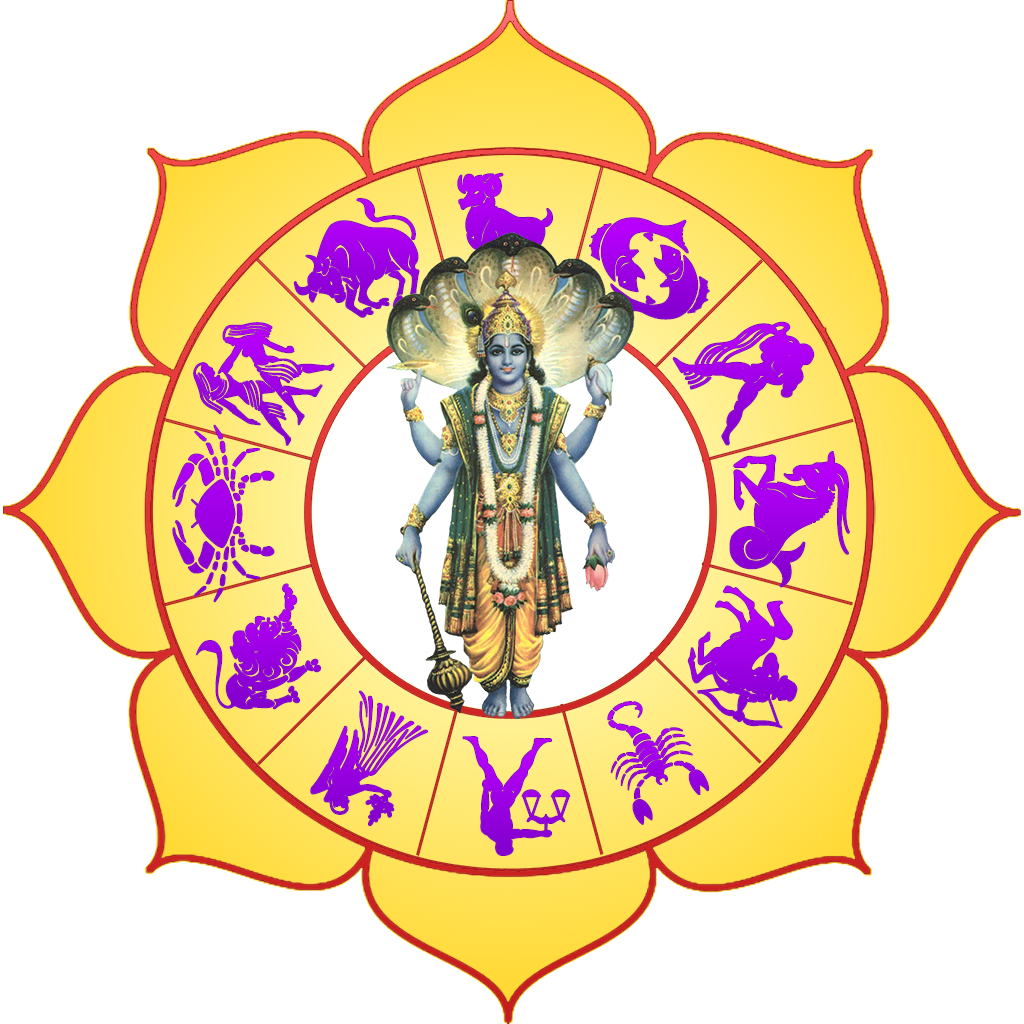
The relative motion between the Sun & Moon shows that the Synodical Month (new moon to new moon or full moon to full moon) is 29D 12H 44M 3S = 29.53059D. Rounding off to the next higher integer we get 30 days during which, the average solar motion is 30 Degrees. Finally, dividing the Bhachakra of 360 degrees by 30, we get 12 signs, or the 12 sun signs as the Sun2 gets over-lordship of all signs being their pater. The twelve signs are Mesha (Aries), Vrisabha (Taurus), Mithun (Gemini), Karkata (Cancer), Simha (Leo), Kanya (Virgo), Tula (Libra), Vrischika (Scorpio), Dhanus (Sagittarius), Makara (Capricorn), Kumbha (Aquarius) and Meena (Pisces).
Figure 1: The Sun sign Zodiac
 |
 |
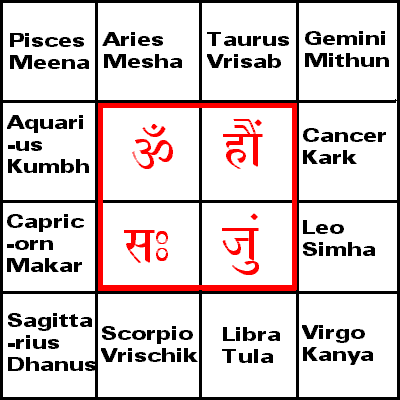 |
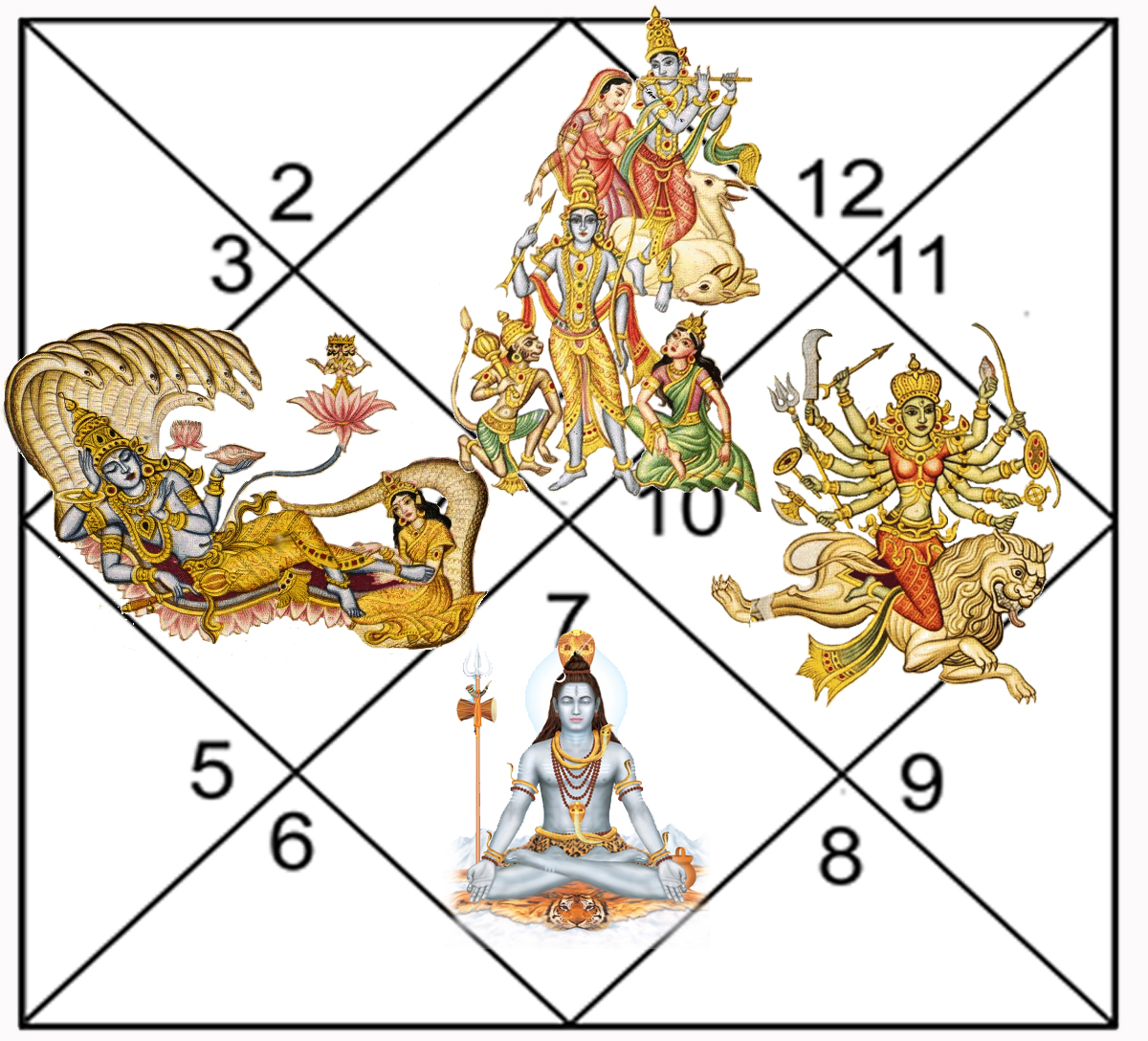
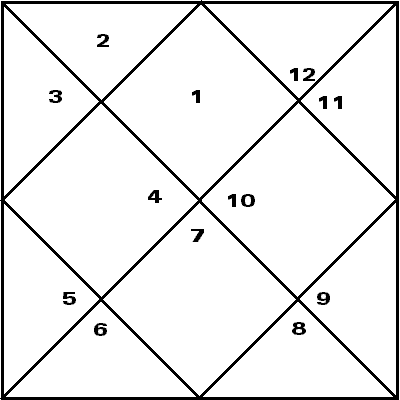
| Sun Chakra | East India | Venus ‘Diamond’ – North, West India | Jupiter ‘Square’ Chakra – South India |
{tab=Kendra}
Kendra (Quadrant)
The beginning of the zodiac was fixed based on the position of the sun on equinoxes i.e. when the days and nights are equally long and this was at the zero degree of Aries and Libra. In this manner, the four crucial points of the zodiac were determined as zero degrees of Aries, Cancer, Libra and Capricorn. The Rishi’s realized that there were actually two zodiac’s – one where the solar system could be considered as an independent system in itself and another in which the solar systems movement around another ellipse center called VISHNU-NABHI is also accounted for. These two zodiac systems are called Sayana (Tropical) and Nirayana (Sidereal) Bhachakra. The primary difference between the two being the motion of the solar system in the universe which is measured by the period of precession of the equinoxes – 25,800 years and when calculated from the point when the same is zero (i.e. sidereal and tropical zodiac coincide) is called Ayanāṁśa3. Now, the difference between the starting points of the two zodiac’s at any point of time is called Ayanāṁśa. In the concept of the Hindu calendar4 we realize that Varahamihira’s advocation of using the Suklanta Masa had a lot to do with the nomenclature of the Months on the basis of the normal Nakshatra position of the Full Moon and this determined the start of each lunar month (and not the Amanta Masa system as is in vogue in most of India today). In any case the star ‘Chitra’ was observed as the point of fixation and ‘Chitra Paksha’ referring to the opposite point from ‘Chitra5’ represents the beginning of the zodiac.
The basic point is that the zodiac was divided into four parts of ninety degrees each by the four points representing the beginning of Aries, Cancer, Libra and Capricorn and that these four points defined the four goals of human existence as (a) Dharma – righteousness and adherence to natural and societal principles (b) Moksha –Spirituality and emancipation from the cycle of rebirth, (c) Kaama – existence of desires and their fulfillment or denial as the cause of rebirth and (d) Artha – wealth. The four parts, on the other hand, divided the life into four ashrams, which form the foundation of Hinduism. This is also the concept in ‘Chatuspada6 Dharma’.
The Sankhya Śāstra teaches extensively about the Pancha Tatwa or the five forms of existence of all bodies. These forms of existence are (1) Prithvi (Solid state), (2) Jala (Liquid state), (3) Vayu (Gaseous state), (4) Agni (Energy state) and (5) Akash (ethereal or vacuum state). Vacuum permeates the entire universe and hence, the Akash Tatwa is present throughout the Bhachakra. The other four Tatwa were found to be in a predominant form in Aries (Agni), Cancer (Jala), Libra (Vayu) and Capricorn (Prithvi).
{tab=Trikona}
Trikona (Trine)
 In a similar manner, the Trikona (trine) should also be understood as being the division of time into three aspects of past, present and future. Using (a) Manu Smriti statement that ‘a day in the life of the Gods is a year in human life’ we arrive at the basic equation of 1 Deg (=day motion of Sun) representing 1 year in Human life, and (b) Parāśara’s statement that the Param Ayus for human beings is 120 years, we arrive at the angle of 120 Degree representing the present life, next 120 deg representing the future and 120 degree representing the past. The span of 120 degrees of the zodiac covers 9 Nakshatra and thus, a group of nine Nakshatra before Janma (birth) Nakshatra represents the past, the group of nine from Janma represents the present while the remaining group of 9 represents the future.
For example, a person born in Satabhisāj nakṣatra (24) shall have this as his Janma nakṣatra (1). See adjoining image where Janma Nakṣatra Satabhisāj (1) is shown as the start of life. The nine nakṣatra from Satabhisāj to Mṛgāśiras (5) represent the present life – janma navtārā. The tenth nakṣatra reckoned from Satabhisāj is Ārdrā (6) which gets the special name of Karma Nakṣatra (10). It indicates the future being shaped by the karma we do in this life. The nine nakṣatra reckoned from Ārdrā (6) to Chitrā (14) represent the future. It includes our children and the generation following the native.
The nineteenth nakṣatra from janma nakṣatra is actually the tenth nakṣatra counted in the reverse. For Satabhisāj the 19th nakṣatra is Svātī (15) which gets the name of Anujanma nakṣatra. The nine nakṣatra from this to the one preceding the janma nakṣatra are in the immediate past. They also indicate the generation before the native like parents, elders and guru.
This three-fold division is very fundamental to Vedic Astrology and we have the three types of Chara (Movable), Sthira (Fixed) and Dwisbhava (Dual) signs. Since the three types are based on the original longevity equation of Parāśara (120 Deg = Full life), this is used in the most basic methods to estimate longevity.
{tab=Ritu}
Ritu – The Six seasons
 The change of seasons formed the primary basis for the Hindu calendar where the year was divided into six seasons called Ritu. Rains were considered the blessings of the Gods and the rainy season was considered as that during which life came to this earth. This formed the principle behind determining the life giving portion of the zodiac as well as the concept of the coming down of the individual soul from the heavens above with the raindrops7. The distribution of the seasons in each Ayana, their extent in the zodiac and ruling planets are given in Table-1. Furthermore, the Ritu should be understood only from the solar months8 (i.e. Sun’s transit) and not the lunar months. Since the Sun was accepted as the cause of all seasons, it was natural to give the over lordship of the seasons to him.
Table 1 – Division of the seasons
| Ayana |
Season |
Lord of Season |
Sun signs covered |
Lord | |
|
Winter |
Varsha | Rain | Moon | Cancer | Moon |
| Leo | Sun | ||||
| Sarad | Fall | Mercury | Virgo | Mercury | |
| Libra | Venus | ||||
| Hemanta | Winter | Jupiter | Scorpio | Mars | |
| Sagittarius | Jupiter | ||||
|
Summer |
Sisira | Cold | Saturn | Capricorn | Saturn |
| Aquarius | Saturn | ||||
| Vasant | Spring | Venus | Pisces | Jupiter | |
| Aries | Mars | ||||
| Grisma | Summer | Mars & Sun | Taurus | Venus | |
| Gemini | Mercury | ||||
The seasons are intricately connected to the veda as all knowledge comes from the five sensory faculties that are altered due to the influence of the six seasons. The six vedāñga (limbs of the veda) are Kalpa, Jyotiṣa, Vyākaraṇa, Śikṣā, Nirukta and Chandas. These are connected to the six vedic seasons reckoned from Vasanta (spring) that coincides with Vedic signs Pisces and Aries.
Kalpa means
a) a sacred precept, law, rule or ordinance
b) manner of acting, proceeding, practice (esp. that prescribed by the Vedas)
c) the most complete of the six vedāñga and that which prescribes the ritual and gives rules for ceremonial or sacrificial acts)
d) a fabulous period of time called a day of Brahma or thousand Yugas which equals a period of 4320 millions of years of mortals. It measures the duration of the world after which all creation is destroyed and rebuilt after an equally long period of hibernation. A month of Brahma contain thirty such Kalpa-days and twelve months of Brahma constitute his year. One hundred such years his lifetime. Fifty years of Brahma have elapsed, and we are currently in the 51st Brahma year of the śvetavārāha-kalpa. Kalpānta means the end following the end of the kalpa.
e) Refers to the first astrology house (Varāhamihira Bṛhat Saṁhitā) due to which the first house, called lagna, is associated with Brahma. This season (kalpa) is connected with both the first sign of the zodiac (showing Brahma) as well as the last sign of the zodiac (showing kalpanta, the end of the world) and therefore must be connected with Śiva as well.
f) Refers to Śiva (Mahabharata xii) He is the beginning of everything that ever began as well as the last that there will be when everything ends.
g) Kalpa-vṛkṣa is the tree of paradise
In this manner each of the vedāñga have various meanings and the study of their meanings shows their wide usage. Later we will learn about the Kalpa-druma yoga which associates with this kalpa-vṛkṣa, the celestial wish fulfilling tree and understand how this yoga completely revolves around the lagna.
{tab=Naksatra}
Nakshatra – (Lunar Mansions)
Having divided the zodiac into 12 signs based on the Sun’s movement, it was necessary to also divide this into parts to study the effects of the movement of the Moon. Considered independently, the Moon takes 27D 7H 43M 11.5S to go around the earth. This is called the Sidereal month. Taking the integer 27 we get the 27 Nakshatra or Lunar Mansion (each 130 20’ of arc). Each Nakshatra was identified with a star, (or star cluster) and derived its name from it. The 7-¾ hour shortfall in a sidereal lunar transit was made up by a short-span intercalary (hypothetical) Nakshatra called Abhijit. The span of Abhijit is determined proportionally as (7h 43m 11.5s/ 24 hrs) x 130 20’ = 40 17’ 20″. This span is from 2760 40’ to 2800 57’ 20″overlapping the 21st Nakshatra (Uttarasadha). This becomes the 28th Nakshatra, which is used in some Chakra like the Kala Chakra and the Sarvatobhadra Chakra etc.
Table 2: Nakshatra – Lunar Mansion
| Number | Nakshatra | Deity | Planetary Lord-ship (Vimśottari) | Pada3°20’ each | Extent in Rāśi | Rāśi |
| 1. | Aswini | Aswini Kumar | Ketu | 4 | 13°20’ | Aries (Mesh) |
| 2. | Bharani | Yama | Venus | 4 | 16°40’ | |
| 3. | Krittika | Agni | Sun | 1 | 30° | |
| 3 | 10° | Taurus (Vrisabha) | ||||
| 4. | Rohini | Brahma | Moon | 4 | 23°20’ | |
| 5. | Mrigasira | Chandra | Mars | 2 | 30° | |
| 2 | 6°40’ | Gemini (Mithun) | ||||
| 6. | Ardra | Rudra | Rahu | 4 | 20° | |
| 7. | Punarvasu | Aditi | Jupiter | 3 | 30° | |
| 1 | 3°20’ | Cancer (Karkata) | ||||
| 8. | Pusya | Brihaspati[9] | Saturn | 4 | 16°40’ | |
| 9. | Aslesha | Sarpadeva[10] | Mercury | 4 | 30° | |
| 10. | Makha | Pitri[11] | Ketu | 4 | 13°20’ | Leo (Simha) |
| 11. | Poorva Phalguni | Bhaga | Venus | 4 | 16°40’ | |
| 12. | Uttar Phalguni | Aryama | Sun | 1 | 30° | |
| 3 | 10° | Virgo (Kanya) | ||||
| 13. | Hasta | Savitur[12] | Moon | 4 | 23°20’ | |
| 14. | Chitra | Tvashta | Mars | 2 | 30° | |
| 2 | 6°40’ | Libra (Tula) | ||||
| 15. | Swati | Vayu | Rahu | 4 | 20° | |
| 16. | Visakha | Mitra | Jupiter | 3 | 30° | |
| 1 | 3°20’ | Scorpio (Vrischika) | ||||
| 17. | Anuradha | Saturn | 4 | 16°40’ | ||
| 18. | Jyestha | Indra | Mercury | 4 | 30° | |
| 19. | Moola | Nirriti | Ketu | 4 | 13°20’ | Sagittarius (Dhanus) |
| 20. | Poorva Ashada | Jala[13] | Venus | 4 | 16°40’ | |
| 21. | Uttar Ashada | Viswadeva | Sun | 1 | 30° | |
| 3 | 10° | Capricorn (Makara) | ||||
| 22. | Sravana | Vishnu | Moon | 4 | 23°20’ | |
| 23. | Dhanista | Asta Vasava[14] | Mars | 2 | 30° | |
| 2 | 6°40’ | Aquarius (Kumbha) | ||||
| 24. | Satabhisaj | Varuna | Rahu | 4 | 20° | |
| 25. | Poorva bhadrapada | Ajaikapad | Jupiter | 3 | 30° | |
| 1 | 3°20’ | Pisces (Meena) | ||||
| 26. | Uttara bhadrapada | Ahirbudhanya | Saturn | 4 | 16°40’ | |
| 27. | Revati | Pooshan | Mercury | 4 | 30° |
{/tabs}
1 Kala- time, Purusha – God personified as Man. Hence, Kalapurusha is the personification of time as the ultimate representation of God.
2 Hence the name Rasi where Ra refers to the Sun God.
3 Different average rates of precession have been given for Ayanāṁśa, but the fact remains that Surya Siddhanta has been very close to the truth in using 24000 years!. The average rate is 360 Degrees divided by 25,800 years = 50.232558 seconds per year. Note also that the word is composed of ‘Ayana’ + ‘Āṁśa’ or literally, portion of the Ayana.
4 Refer appendix-1 for details.
5 Here we are referring to the Yogatara of Chitra.
6 Chatuspada literally means four feet and also refers to the sign Sagittarius which is the ninth house representing ones fortune or Bhagya. The four feet of Dharma are defined as the duty towards (a) Universe/Nation (b) Society (c) Family and (d) self in that decreasing order of importance. It is noteworthy that Parasara uses the term ‘Bhagya’ while referring to the Chaturthāṁśa’s results.
7 The Brhadaranyaka Upanishad explains the Karma theory with reference to the theory of Transmigration of the soul (sāṁśara). The pious and good souls who have lived a dharmic life depart for the abode of the forefathers and other such loka. After a period of temporary bliss, they move on to emptiness via the Moon. From emptiness, they descend to the earth with the rain and enter the food that is consumed by the prospective father. From the food they become spermatozoa and are offered to the prospective mother in the altar of fire (copulation). Then the birth occurs. The Upanishad adds that the unrighteous are incarnated as birds, insects, animals or plants on the basis of the Karma of the past lives. It is generally taught that conduct and adherence to the moral code determined these changes. Thus good karma would promise an exalted future while bad karma will tend to degrade the soul in the lines of ‘ as you sow so will you reap’. This doctrine of Karma (literally “action”) provides a very satisfactory explanation for the various social inequalities that exist as well as the troubles or grief that one faces as it is the result of one’s own acts or misdeeds in the past. These Karma are divided into two categories called Sanchita and Prarabdha. The results of Sanchita Karma will be exhausted in the various heavens and hells after death whereas only experiencing them can lessen the results of Prarabdha Karma. Thus, it is this Prarabdha Karma, which is the cause of rebirth.
8 indicated by Mukunda Daivagyna in Nasta Jataka
9 Jupiter
10 Snakes ruled by Rahu
11 Pitri refers to the forefathers and when the Sun is in this place, in the Krishna Paksha (called Pitri Paksha), the devout Hindu worships the manes and forefathers.
12 Others – Vishwakarma, Aditya etc.
13 Water personified as the protector
14 Vasudeva