Definition

| VA | West[1] | VA | |||
| Graha | Exalt | D | D | Fall | D |
| Sun | Ar | 10 | 20 | Li | 10 |
| Moon | Ta | 3 | 3 | Sc | 3 |
| Mars | Cp | 28 | 28 | Cn | 28 |
| Merc | Vi | 15 | 15 | Pi | 15 |
| Jup | Cn | 5 | 15 | Cp | 5 |
| Ven | Pi | 27 | 27 | Vi | 27 |
| Sat | Li | 20 | 21 | Ar | 20 |
| Rāhu | Ge | Ta | 3 | Sg | Sc |
| Ketu | Sg | Sc | 3 | Ge | Ta |
In Vedic Astrology, exaltation is one of the six essential dignities of a planet (Babylonian astrology uses five essential dignities instead and calculates them differently). Each of the seven traditional planets has its exaltation in one zodiac sign. This exaltation is its ‘uccha bala’ or rising power. We will understand these exaltations when we study ṣaḍbala, the six sources of strength.
Exaltation and debility of the planets is the oldest astrological feature perhaps predating the very zodiac. In which case, the exaltation and debility must have their roots in the degrees of the bhā-chakra and in the nakṣatra. Many modern thinkers believe that Indian astrology was borrowed from the Greeks, but this one fact contradicts their thinking as the Indian and Greeks disagree with the exaltation degrees which forms one of the fundamental elements of their astrology. Secondly, in practice, Vedic astrology makes extensive use of this element while western astrology treats it like an ornament.
Albiruni, The Book of Instruction in the Elements of the Art of Astrology, ch.444: Hindu’s differ as to degrees’: “There is no difference of opinion as to the signs of exaltation, but the Hindu’s differ as to the degrees in certain cases. They are agreed that the exaltation of the Sun lies in 10° of Aries, of Jupiter in 5° of Cancer, of Saturn in 20° of Libra,
the others as above, except with regard to the Dragon’s head [Moon’s north node] and Tail [Moon’s south node] which are not mentioned by them in this connection as is quite proper.
Effects of Exaltation or Fall
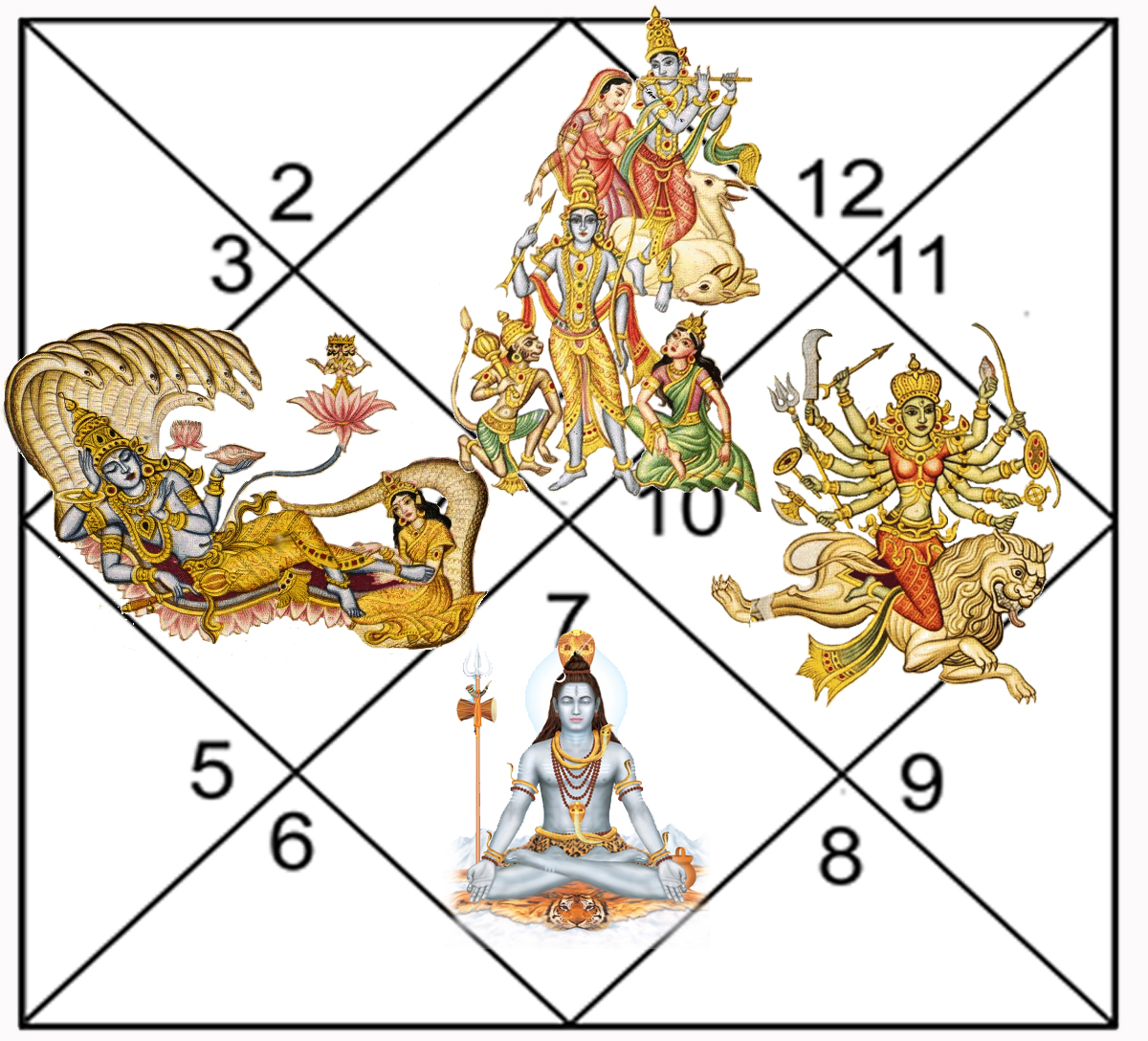
A planet in debility (fall) shows its lordship (house, bhāva) diminishing (falling) while one in exaltation shows the bhāva increasing. If the planet is retrograde, then the reverse shall happen as it gives the results of the opposite sign. If it is exalted and retrograde, it gives the results of opposite sign which is its sign of debility. While the results, or fruits are those of loss and diminution, the effects of its exaltation like high thinking and morals or ethics shall not go away. For this reason, Viṣṇu avatāra must have at least two planets in exaltation of which the planet indicating their avatāra powers must be exalted. In the chart of Śrī Rama the Sun is exalted while Śrī Kṛṣṇa has exalted Moon. Similarly, Narasiṁha is exalted Mars, Budha-avatāra is exalted Mercury, Śrī Vāmana is exalted Jupiter, Śrī Paraśurāma is exalted Venus, Śrī Kūrma is exalted Saturn, Śrī Varāha is exalted Rāhu and Śrī Matsya is exalted Ketu.
Pūrṇimā Symbol
| Graha | Ex | Viṣṇu | Fall | Kālikā |
| Sun | Ar | Rama | Li | Mātaṅgī |
| Moon | Ta | Kṛṣṇa | Sc | Bhuvaneśvarī |
| Mars | Cp | Nṛsiṁha | Cn | Bagalāmukhī |
| Mercury | Vi | Buddha | Pi | Tripurā |
| Jupiter | Cn | Vāmana | Cp | Tārā |
| Venus | Pi | Paraśurāma | Vi | Kamalā |
| Saturn | Li | Kūrma | Ar | Kālī |
| Rāhu | Ge | Varāha | Sg | Chinnamastā |
| Ketu | Sg | Matsya | Ge | Dhūmāvatī |
| Lagna | Kalki | Bhairavī |
Exaltation point is like pūrṇimā (full moon) and debilitation point is like amāvāsya (new moon) for a planet. Therefore, when a planet falls from its exaltation to its debilitation point, it is said to be अवरोह (avaroha) or falling like the kṛṣṇa pakṣa moon. When it rises from its debility to its exaltation point, it is said to be आरोह (āroha) or increasing like the śukla pakṣa moon. In Vedic astrology one of the important concepts is ‘śukla pakṣa is Viṣṇu pakṣa, kṛṣṇa pakṣa is rudra pakṣa’. The planet which attains exaltation has the energy of the Viṣṇu avatāra whereas the planet which attains debility needs the śaktī of the Kālikā avatāra (Mother Divine). Planets in āroha are in their Viṣṇu pakṣa whereas planets in avaroha are in their rudra pakṣa. In this manner the Mahāvidyā were linked to the Avatāra, and they are exactly ten in number.
Raja-bhaṅga (cancellation of exaltation) causes the bhāva to suddenly suffer while nīca-bhaṅga (cancellation of fall) causes the bhāva to suddenly rise [We learn these under ‘Yoga’ next year].
Examine Exaltation Degree
Since the exaltation degrees of planets were known even before the advent of the zodiac, it goes without saying that these degrees are actually absolute degrees of the zodiac. Later when the knowledge of the signs was revealed, these degrees were mapped into the signs. For example, the exaltation of Saturn is in 200° which is also Libra 20°.
Secondly, the word ‘bhā-chakra’ refers to the nakṣatra chakra having 27 lunar mansions with 4 pada in each nakṣatra (total of 108 nakṣatra pada). This is a feminine view of the universe as the lunar mansions are related to the periods of women and their fertility and delivery, which is the birth of baby. Later, the rāśi (fixed zodiac) was carved out by taking 9 nakṣatra pada to equals 1 rāśi. Later, when divisional charts were known, the second most important divisional chart was the Navāṁśa as one nakṣatra pada was equal to one navāṁśa. As a first step to understanding exaltations and comparing the statements of the East (India, Vedic) and West (Babylon, Greek), let us map the exaltation degrees into nakṣatra. The difference of opinion are related to the exaltation (and fall) degrees of Sun, Jupiter and Saturn primarily and also the nodes.
| Vedic, India | Babylon, Greek | Vedic, India | ||||||||||||
| Graha | Exalt | Deg | ★ | Nakṣatra | Deg | ★ | Nakṣatra | Fall | Deg | ★ | Nakṣatra | |||
| Sun | Ar | 10 | 10 | 1 | Aśvinī | 20 | 20 | 2 | Bharaṇī | Li | 10 | 190 | 15 | Svātī |
| Moon | Ta | 3 | 33 | 3 | Kṛttikā | 3 | 33 | 3 | Kṛttikā | Sc | 3 | 213 | 16 | Vaiśākha |
| Mars | Cp | 28 | 298 | 23 | Dhaniṣṭha | 28 | 298 | 23 | Dhaniṣṭha | Cn | 28 | 118 | 9 | Aśleṣā |
| Merc | Vi | 15 | 165 | 13 | Hastā | 15 | 165 | 13 | Hastā | Pi | 15 | 345 | 26 | Uttara bhādrapada |
| Jup | Cn | 5 | 95 | 8 | Puṣyā | 15 | 105 | 8 | Puṣyā | Cp | 5 | 275 | 21 | Uttara Āsāḍha |
| Ven | Pi | 27 | 357 | 27 | Revatī | 27 | 357 | 27 | Revatī | Vi | 27 | 177 | 14 | Chitrā |
| Sat | Li | 20 | 200 | 16 | Viśākhā | 21 | 201 | 16 | Viśākhā | Ar | 20 | 20 | 2 | Bharaṇī |
| Rāhu | Ge | 20 | 80 | 7 | Punarvasu | 3 | 63 | 5 | Mṛgāśirā | Sg | 20 | 260 | 20 | Pūrva Āsāḍha |
| Ketu | Sg | 20 | 260 | 20 | Pūrva Āsāḍha | 3 | 243 | 19 | Mūla | Ge | 20 | 80 | 7 | Punarvasu |
According to Vedic Astrology Sun exalts in Aśvinī nakṣatra which has Aśvinī Kumar, the healers who rejuvenate, revive and give eyesight, as the devatā whereas according to the Greeks Sun exalts in Bharaṇī nakṣatra which has Yama, the god of death and after-life as the devatā. It is evident then that Vedic Astrologers found this hard to accept as the Sun represents good health, rejuvenation and coming of the world to life. He represents eyesight and gives vision to the world. From the point of nakṣatra jyotiṣa, the Sun must exalt in Aśvinī nakṣatra which carries its healing powers rather than Bharaṇī which has death energies associated.
For Jupiter and Saturn, the exaltations, both in Vedic and Greek astrology is in the same nakṣatra – Puṣyā and Viśākhā respectively. Jupiter must be exalted in Puṣyā in order to gain the power of life called ‘jīva’ while Saturn must exalt in Viśākhā to gain the purity is craves for from Indra-agni (devatā). Saturn constantly suffers from impurity and without this cleansing, it can never be free from sins. For this reason, the best remedies associated with Saturn are always related to purification. These include giving a bath (water offering) to Lord Śiva called Rudra-abhiśeka as well as repetition of the name of Viṣṇu which gives purity to all the worlds. Jupiter’s exaltation in Puṣyā is to with the secret of life, which is learning that leads to knowledge. Information, learning and knowledge is the key to survival in this planet. Even animals retain information about their food sources and water. This memory power comes from Puṣyā nakṣatra and differentiates the jīvātmā from the jaḍātmā. There must be another process of examining the differences between the degrees of exaltation of Saturn and Jupiter using which the Vedic Astrologers disagreed with the Greeks.
Coming to Rāhu, the ascending node, Vedic astrologers accept its exaltation (material world, bhoga) in Gemini just as the Greeks do. Yet they differ on the degrees as they prefer the exaltation in Punarvasu nakṣatra ruled by Aditi whereas the Greeks show the exaltation in Mṛgāśiras nakṣatra ruled by the Chandra, the Moon God. Punarvasu means ‘return of light’ or the ‘return of life’ and represents rebirth and is the perfect nakṣatra for Rāhu to derive his great power to cause the rebirth of every soul. This is the high watermark of Rāhu’s power. It is very hard to accept any logic for Rāhu to get exalted in Mṛgāśiras the nakṣatra of its sworn enemy the Moon.
Similarly Ketu is exalted in Pūrva Āsāḍha nakṣatra ruled by Jala devī. This nakṣatra represents the end of Kali Yuga when complete destruction of the worlds occurs. It is ‘Pralaya sūcaka nakṣatra’. At this time all souls, irrespective of their karma, shall get mokṣa. Ketu being the mokṣa-kāraka gains its great power from this Pūrva Āsāḍha nakṣatra. Although Ketu is the lord of Mūla nakṣatra, it does not derive any special power from it. Mūla symbolizes the root and is definitely linked to Ketu but it does not represent the power to exalt Ketu, the mokṣa-kāraka.
Illustration: President Obama

In the chart of Barrack Obama, the Moon is in its exaltation sign in Taurus while Jupiter is in its debility sign in Capricorn. Moon in the 5th house gives many friends (dṛṣṭi 11H of friends), popularity and being in exaltation it gives great success and fame. As such it is the lord of the 7th house placed in 5th bhāva showing devotion to the almighty Śiva (Holy Father) and this brings power, position and fulfillment of all desires.
The aspect of the Moon on the 11th house brings many friends and supporters but this is Scorpio, its sign of debility. Therefore this may prove to be his undoing or fall of the significations of the Moon. Friends may end up using his goodwill. It is evident that whenever a planet is exalted, it shall aspect its sign of fall and this is its weak spot.
Jupiter is debilitated in Capricorn and being in fall it destroys the significations of the houses it shall own, and not the house it is placed it. Jupiter is the lord of the 3rd and 12th houses which are generally classified as bad houses. Therefore the placement of Jupiter in debility is a kind of blessing in disguise as it damages secret enemies in the 12th house and challengers in the 3rd house. A retrograde Jupiter is truly beneficial when in debility as then it gives the results of its opposite sign Cancer. And we know that Jupiter in Cancer is exalted. Therefore during the period of Jupiter he rose, slowly and surely to become a senator. In any case we can say that the exalted Moon brings the blessings of Kṛṣṇa promising huge popularity and success in destroying enemies (Osama Bin Laden for example). We can also say that the debilitated Jupiter needs Tārā śaktī to get activated, and this must have happened for him to attain the high position. How did this happen? (A) Moon, the lord of exaltation sign of Jupiter is exalted, (B) Saturn the lord of debility sign of Jupiter is in kendra from
Lagna and in Mahāpuruṣa yoga and conjoins Jupiter, (C) Mars the planet which gets exalted in Capricorn, the debility sign of Jupiter is placed in kendra from the Moon. Can you remember these three rules which help a weak planet get support and strength to rise?
Moon is the lord of Cancer and is in the 5th house from Jupiter besides being the lord of its exaltation sign. During the conjoined period of these planets Jupiter daśā Moon antardaśā, his popularity soared and he became the President of the United States. In this manner we see how planets in exaltation or in debility can dramatically alter life. These are powerful positions and should be studied carefully.
Some of you may give an argument that Jupiter is conjoined Saturn whose results he is sure to give. Now we know that Saturn is in Sasa Mahāpuruṣa Yoga and has astoundingly high ṣaḍbala (188). Besides it is retrograde and gives the results of being in Cancer. It is said that Jupiter in Pisces and Saturn in Cancer are sure sign of rājayoga as they have the strength of Tārā Mahāvidyā. In fact Jupiter and Saturn in water signs give the powers of Tārā while these planets in wind signs bring the might of Kālī Mahāvidyā. Perhaps for this reason the three wise kings of the east went looking for a baby (Jesus) when Jupiter and Saturn conjoined in Pisces. In any case if Jupiter was giving its own nīcabhañga or the conjunction with Saturn, both results were one of rājayoga.But then by the same argument, Saturn should be giving the rājayoga of Jupiter plus its own power, and Saturn daśā starts only in July 2012. Till then Obama has to deal with a terrible Rāhu spoiling the rājayoga of Jupiter by pāpa-argalā (8th house from Jupiter) as well as pāpa-argalā on Moon (4th house).
As usual there will be so many new words and terms that you don’t know. Do not worry about it but keep adding it to your TO-DO list. Those who know what they do not know are surely wiser than those who do not know what they do not know.
Assignment: Examine the Exaltation and Debilitation of Graha in the nakṣatra listed in the Lesson with particular emphasis on the mental powers they derive from these nakṣatra. We have explained the exaltation for some of these planets in the lesson. There must be no reference to the zodiac signs.
Assignments have to be submitted to your Jaimini Scholar guide who will grade you and send final grade-sheet to Certification head.